
Additional Thought on Women's Studies
ADDITIONAL THOUGHT ON WOMEN’S STUDIES
“Ministry Before Consensus”
Virgil Warren, PhD
Some additional questions arise from previous presentations on women’s studies. For one thing, I have used “ministry” in the title of a paper that centered on leadership in relation to women's roles. “Ministry” is broader than leadership, but leadership is the area in which disagreement about women's roles has arisen. One way to help resolve controversial issues is to appeal to the larger category in which they stand. A title about “ministry” is useful on this subject because women are clearly free to make significant contributions to kingdom work; the question is whether they are free to make contributions in formal leadership ministry over men. Ministry as the larger category sets the context for leadership ministry. Any distinctive elements in the latter must be added in such a way as not to contradict the larger framework. The thesis in “Ministry Before Consensus” has been that we can carry forward the kingdom's work significantly and with minimal negatives even before we resolve the problem. We can do that if we keep the problem clearly defined, if we keep it from spilling over into foreign issues, and if we maintain a proper understanding of Christian leadership. Women's formal and informal Christian leadership ministry needs to conform to Christian leadership ministry generally, Christian leadership ministry needs to take place in a way that harmonizes with Christian ministry, and Christian ministry of every sort must retain the characteristics of interpersonal process. Since it is ministry that we want to get done, ministry is the subject area.
A related question is whether “ministry of Christians in the church (men or women) can be considered apart from leadership issues.” Some ministry is neither informal or formal leadership, but again that is not the kind of ministry women's roles
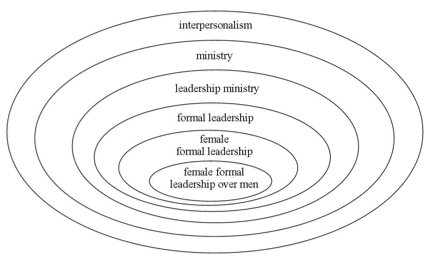
raises questions about. Furthermore, informal leadership, which is through influence alone, is also not part of the current issue—or at least ought not be; everyone should influence people for Christ in whatever ways he can, both inside and outside the church community. The issue is whether the New Testament restricts women from serving in ultimate formal leadership roles that have supervisory authority over men; should women teach or lead “offic-ially”? We cannot consider ministry apart from leadership issues, because the area of disagreement is about women's exercising formal leadership over men. Minimizing that difficulty can come from a proper understanding of Christian leadership and other more basic relevant categories. The values and characteristics of those basic categories are retained in the more specialized ones. If we practice the more fundamental issues correctly, we avoid much of whatever danger could come from wrong conclusions about the most specialized area.
The previous paragraph assumes a view of leadership ministry that retains supervisory authority in some places. To avoid excesses and misuses of authority, some have tried to eradicate authority from church structure altogether. Despite the claim that no authority exists in the church (Christ has been given all the authority in heaven and on earth), these interpreters do not in fact operate without using authority; they simply emphasize cooperation and consensus. Their idea seemingly works only because good leaders who have authority do most of their leading without it; they lead by influence most of the time. The result feels like cooperation, as it should; but the responsibility and right to decide nevertheless exists, and is called upon from time to time when influence does not suffice for practical reasons. Instead of discarding authority because of its abuses, we do better to stress responsibility, understanding that authority comes into the picture only to reinforce responsibility.
We may add the fact that the church is a voluntary society; if authority becomes “lording it over the flock,” people just leave. That practical fact impacts the extent to which authority plays its role in the body of Christ.
A question also arises as to why 1 Timothy 2 was “the one New Testament text” used in the paper as the base for "the major generalization about women's work in the church." The reason for referring to that context was not so much that it is the only one relevant to the issue of men-women relationship in church roles (vs. home roles), but because in it is the fullest, clearest, and apparently most straightforward one on that topic. Even if it were the only one that touched on the question, it we would still need to hear it, because we take a view of scripture (and apostolicity in canonicity) that guarantees the propriety of apostolic directives aside from any number-of-references consideration. Again, in accordance with the view of scripture assumed in these studies, a harmony of viewpoint within the subject area was assumed across the texts that in various ways relate to men-women relationship generally. This observation tends to balance the presentation and thereby avoid extremes by listing the religious (and non-religious) activities we know biblical women did; these other texts are among “the other many texts” relevant to the women's-roles question. Galatians 3:28 and other texts on related topics are not dealt with individually because of space and time.
As regards related topics, I have supposed that a timeless pragmatic variable harmonizes man-woman equality as per Galatians 3:28 (theoretical) with role-emphasis diversity as per 1 Timothy 2 (practical); role assignments for men and women correlate with the relative gifting of men and woman (nature), that relative gifting being statistical by degree more than kind. Furthermore, the structure of the church should mesh with the structure of the home. (Besides topics related to men-women relationships, we should look at consistency in reasoning on subjects we consider cultural issues: slavery, veil-wearing, and the like.)
In addition to a difference based on (a) assumed relative gifting, opting for divine role assignment rather than situational directive depends in part on (b) the kinds of reasons texts give: Adam was first formed, then Eve (1 Timothy 2:13); Eve was deceived, but Adam was not (1 Timothy 2:14); the woman is the weaker vessel (1 Peter 3:7); Adam was created (more directly?) in the image of God (1 Corinthians 11:7). These reasons are rooted in history and nature, which do not change with time and place. Admittedly the texts do not say explicitly why these reasons are reasons or in what way they belong to the subject. They could be post facto rather than a priori reasons. In some cases, they could be reasons for the basic principle—female submission—rather than reasons for the cultural manner of signaling that principle. The latter does seem to be the point of Paul's argument for veil-wearing in 1 Corinthians 11 (cp. the document “1 Timothy 2:9-12,” p. 1). It might apply also to "teaching," because cultures can regard teachers and teaching differently. Women's teaching in 1 Timothy 2 does not seem to be explained this way, because their “teaching” is approved in other circumstances. Teaching or not teaching, then, is referenced to differences of circumstance or nature of teaching within the circumstances rather than referenced to the setting/culture itself. Since Paul combines his prohibition with “ruling” men, since he is moving into eldership characteristics, and since teaching and ruling are the two distinctive responsibilities of elders, Paul evidently means that he did not let women do normative, authoritative, or official teaching. Paul's not letting women exercise authority over men (1 Timothy 2:12) could likewise not explain a difference between fundamental principle and the cultural manner of signaling that principle. The underlying principle would be female deference, which is the same thing as not exercising authority over men.
Another consideration is an additional level in the practical application of the female deference principle: whether a culture considers teaching an authoritative function aside from the manner in which a woman carries herself in a teaching endeavor. It also relates to how the teaching situation proceeds: a discussion leader is different from a directive presenter.
Thirdly, opting for some gender-referenced role assignments depends on (c) certain accompanying features of the texts. In another document (“1 Timothy 2:9-15: Situational or General?”), I have assembled factors that seem to indicate that Paul's comments are not meant in a localized or temporary sense. So, his comments in 1 Timothy were not distinctive for Ephesus or for the first century.
chrisstir.org