
Structuring the Hermeneutical Task in Womens Studies: Wisdom or Law?
STRUCTURING THE HERMENEUTICAL TASK IN WOMEN’S STUDIES: WISDOM OR LAW?
Virgil Warren, PhD
Introduction
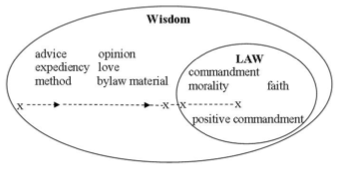
We are inclined to think that some reasonable explanation lies behind the variant understandings of gender roles by equally sincere and capable Christian interpreters. Something must be happening in the minds of some that is not happening in others who likewise take a proper view of scripture. We suspect that part of the difficulty lies at (a) the linguistic level. People do not remember that the imperative mood can have more than one quality, hence, our essay elsewhere on “Imperatival Intent,” which assembles the different values that imperatives and their equivalents may have. Another part of the difficulty lies at (b) the corpus level. People make different assumptions about the nature of the New Testament as a body of normative literature, hence, this essay on “wisdom” vs. “law” and the accompanying excerpt on “Confusing Advice and Commandment.” What we have to say here comes in association with the accompanying diagram.
I. Wisdom
The crux of the issue is whether some New Testament teaching on gender roles derives from “will-of-God” or “wisdom.” Terminology becomes a problem here; so with the aid of the diagram, we explain the differences and the relationship between these concepts. “Wisdom” refers to directives rooted in nature, purpose, and circumstance. It concerns what works effectively, given those factors. Wisdom includes more than timeless absolutes in social behavior and purposeful method. Wisdom includes effective methods, expedient approaches, and loving behaviors; so it speaks in proverbial generalities and makes non-restrictive statements. Since wisdom deals with degree matters as well as either-or options, not taking the advice can be less satisfactory rather than wrong. Wisdom does not imply a “do it if you want to” attitude, because there are reasons for the advice—reasons based in the nature of the case.
Since wisdom covers such a wide range of practical concerns, it includes what churches institute in bylaws. The practical life of the first-century church required them to deal with more than timeless absolutes in behavior and method. Apostolic writings to these churches deal with situational matters that no longer exist in the same form, and do not address matters we must handle now. We do not bring first-century bylaw material and cultural expectancy straight across into our situation. Instead, we extract from it the principles that evidently led to the original apostolic directives and use sanctified imagination to establish procedures appropriate to our context. We must follow that procedure on topics like ours and on topics not addressed.1
This process applies to women’s studies. Although the original nature and purpose of men and women have not changed, appropriate cultural expectancies about their interaction within those boundaries may and do change. We must ask whether some items about men-women and husband-wife interaction are matters of wisdom.
II. Law
“Law” adds authority to wisdom. Law has no pejorative connotation as if it were arbitrary, inflexible, insensitive, impersonal. It means here only that for reasons God deems beneficial, he commands rather than just advises. Not following the imperative moves from risk to disobedience. Under this structuring of the issue, there is no legitimizing potential for human discretion based on revelation and experience about nature and purpose. Since wisdom often states a generality rather than a uniformity, a commandment imperative may also move a generality into a uniformity. Commandment imperatives on gender roles take into consideration relative gifting as surely as wisdom does. Law goes ahead and appoints a division of labor and assigns complementary responsibilities.
The idea is that the best of men are more suited than the best of women to normative teaching and formal leadership roles in mixed settings. The broader referencing, the lower sense of vulnerability, the greater tendency toward goal orientation, the more even mood patterns, and other psychological and physical factors better constitute men for final leadership roles. The differences between men and women in these and other ways are statistical by degree. It is not that women lack these qualities, but that the degree of them is different with certain exceptions. The situation is comparable to physical strength and motor coordination. Men are stronger than women although some women are stronger than some men. Similarly, on the basis of relative gifting, with certain exceptions final leadership responsibilities are better left to men in the home and the church; so God makes a uniformity out of a significant generality; and by using a command imperative, he turns risk to disobedience.
The following may be reasons God might make a rule rather than stop with advice. (1) God might speak authoritatively for the sake of good order, exceptional cases being overridden by mandate. As God did in the first covenant and as we do with children and people inadequately prepared to think through decisions satisfactorily, God “makes a rule.” The implication is that any “difficulty” created by the rule is not as great a problem as the risks of letting fallible people work things out from limited perception and experience. To avoid power struggles, for example, between man and woman in marriage or men and women in the church, he appoints the leadership ahead of the process. That eliminates competition for generating leadership; egalitarianism fosters competition. Leaving the issue to wisdom would “do more harm than good.”
(2) God knows best how he made us, and he wants what is better for us, the home, and the church, not just what will work or what “won’t hurt anything.” What was best for the cause of Christ, is what prompted Paul to handle the first-century slavery problem the way he did. He seems to have dealt with it in a will-of-God fashion born out of wisdom. So to speak, out of a larger concern he gave command imperatives based on wisdom. In 1 Timothy 6:1-2 he uses imperatives about slaves respecting their masters; then in 6:3-4 he says, “If anyone teaches a different doctrine . . . he is puffed up. . . .” (It may be, however, that in 6:3 he has moved beyond the slavery topic.)
(3) We may not be able to see that the gender roles God assigns are, in fact, good in all cases. Deference to love is always a reasonable expectancy. The complexity of relationships and of the roles in relationships may obscure the fact that the kind of man a godly woman would marry is the kind of man she would not try to lead. That fact in the home needs to exist in the church. Normative teaching, for example, is not just a matter of intelligence, knowledge, and verbal skills; it is also a matter of strength, something women do not project as easily as men.
(4) Such a command imperative does not stifle exceptional women who have gifting for teaching without limitation should use their talents in the form of influence with anyone, men included. A sense of security and confidence must accompany formal leadership and credible teachers. Women’s difficulty in projecting strength means that they have difficulty projecting security and confidence. The strength we are speaking of here is not determination strength, character strength, strength to face adversity and pain, but vulnerability strength.
After opting for command imperative on gender roles and spouse roles, we still need to decide whether God means that command in the sense of a standard situation only; that is, married with children. As it works out in practice in the modern church, a high percentage of those women who seem most legitimately to aspire to normative teaching and formal leadership roles are women who are not in the standard situation or in it anymore. Besides, capable women can often use their influence indirectly on those who do have final responsibility, those who should be willing to listen as well as decide and tell.
The difference between wisdom and law relieves apparent discrepancies within scripture. The proverbial writer says, “Don’t look on the wine when it is red” (Proverbs 23:21), but in Romans 14:21 Paul implies that drinking wine is not wrong in itself: “It is not good . . . to drink wine . . . whereby my brother stumbles.” (See other illustrations in “Confusing Advice and Commandment” inn interpretation materials) But more important for our purposes here, the difference between wisdom and law helps explain readers’ variant approaches to the same issue in scripture.
III. The Relationship Between Wisdom and Law
A. Wisdom is a larger category than law. The circles are one-within-another, not parallel, overlapping, or congruent. What God commands is always wise to do, but not every wise thing he tells us to do is meant in the sense of commandment (see “Imperatival Intent”). “Commandment” is an imperative that we disobey if we do not do. Wisdom gives advice that we take a risk if we do not do. The speaker either has no authority over the hearer or chooses not to base the imperative in that authority. Instead, the speaker bases it only in the nature of the case.
There are two circles, not just one. Not everything is wisdom-vs.-law and not everything is law; there is both advice and commandment. God has authority earned by grace. Consequently, there is more to what he says than advice on how to act; by virtue of his own greatness, his creating us for purpose, sustaining us by power, and redeeming us in love, he has a natural and earned right to direct our activities. On the other hand, not everything he says is based distinctively in his authority after the nature of the case. God treats us with the dignity appropriate to the nature and purpose he gave us;2 he treats us interpersonally rather than authoritatively. He directs us through influence rather than by authority or force. Law overlays interpersonal reality. “Legal” authority backs up interpersonal influence when influence is not sufficient, and force (omnipotence) backs up both.
In law, we include moral commandments as well as positive commandments about performative acts. And, for the sake of completeness, even in moral and positive commandments we would remove imputation of disobedience in cases of honest ignorance and sincere repentance.
B. There are degrees of uniformity in God’s imperatives both about advice and commandment. As we move toward the center of the circle, the fewer are the exceptions and the stronger the generality.
C. On issues that lie near the inner circle, we may experience greater hermeneutical uncertainty as to whether an imperative means advice or commandment. That greater uncertainty, however, correlates with less difference in viewpoints; so in practical church life, personal and interpersonal factors along with proper leadership theory keep the problem from becoming a problem in gender roles—or elsewhere, for that matter (see “Ministry Before Consensus”). That greater uncertainty is also compensated for by grace that does not impute honest ignorance and sincere repentance.
D. The task is to decide whether a text like 1 Timothy 2:11-12 represents wisdom or law, whether it belongs outside or inside the smaller circle. Clarifying the law-wisdom distinction does not settle whether a given scripture falls into the wisdom category. The same imperative could be meant either as commandment or advice. The difference does not lie in the nature of the subject matter but in the intent of the speaker. In fact, since the epistles—particularly the pastorals—serve temporary as well as permanent purposes, on items of a bylaw nature what an apostle may have meant as commandment-of-law for the original setting would not necessarily involve disobedience in a different setting. The item could shift from the inner to outer circle.
E. The hermeneutical task is shaped by the fact that wisdom-outside-of-law involves a lesser claim than law does. It calls for evidence that the less specific category cannot account for. If such evidence is not forthcoming, we make the lesser affirmation or at least keep the higher affirmation as opinion. We do not give priority to wisdom or to law and then say that it is the other unless we can disprove that it is the first option. Otherwise, the burden of proof falls on the negative and a hermeneutical victory occurs by default—another way of saying it is subjective.
F. The size of the circles does not picture the proportion of New Testament material in each category.
IV. Observations Favoring a Wisdom Approach
A. Wisdom fits with interpersonalism as the Christian worldview. Interpersonalism correlates with egalitarianism, influence, and advice. Hierarchy correlates with authority and command. Hierarchy is allowed in interpersonalism, but as an overlay rather than the primary factor, and it functions in the scope and manner of the more primary category in areas where it does operate.
B. Wisdom fits with the fact that the New Testament contains more than one type of practical material. The New Testament is more basically a book of wisdom than a body of law. That verdict correlates with the nature of the New Covenant as interpersonal. The epistles serve more than one level at the same time. These are inspired, permanent documents for the whole church age as well as problem-solution documents that direct timeless truth at first-century situations. The pastoral epistles especially deal with practical matters in a particular setting, which includes bylaw subjects. Paul’s purpose in writing 1 Timothy is given in 3:14-15: “I am writing these things to you, hoping to come to you soon; but if I delay very long, [I am writing] so you may know how members need to behave in the house of God.” That agenda involves practical directives that may not hold true for every society throughout the Christian dispensation. Though they may have been command imperatives for the initial readership, they may not necessarily be commands for different circumstances any more than the bylaws of one congregation—though needing to be followed by that congregation—would be binding on other churches founded by the same evangelist. More than one approach may fit depending on the degree of faith in those addressed.
C. Wisdom fits with the experiential fact of relative giftedness in a statistical sense by degrees. Wisdom allows for equal access vs. equal admission; it creates a “level playing field,” which seems fairer. Natural and practical/cultural considerations continually factor out women from the final authoritative roles in mixed settings in church and home. The percentage of women in leadership will not be that different under wisdom from what it would be under law.
D. Wisdom fits with the scriptural fact that there are exceptions to the male leadership pattern (Deborah, for example).
E. Wisdom fits with the historical fact that there has never been a matriarchal society.
F. Wisdom fits with the kind of reasons given for women in standard situations not officially leading men in the final slots of service within the church. They are reasons for advice rather than commandment; not doing them would be unwise, not disobedient.
G. Wisdom on female deference in the church fits with the psychology of sexual intimacy in marriage.
H. Wisdom could allow for women to hold responsibility positions over men by delegated authority because such positions would not be the ultimate slots of service in the church.
I. Wisdom fits with the idea of assumed frame of reference. It can acknowledge the cultural variable and overriding purpose—so that the name of God may not be blasphemed (cp. 1 Timothy 6:1; Titus 2:5).
J. Wisdom fits with the distinction between basic principle, which is constant (female deference), and the manifestation of that principle, which is situationally variable (veil-wearing, deference behavior).
V. Observations Favoring a Law Approach
A. 1 Timothy 2:11-12 is not as likely to be wisdom if it connects with the subsequent context on eldership characteristics. Doing so would open up the possibility of women elders as well. (See “Notations on 1 Timothy 2:11-12.”)
B. We cannot leave 1 Timothy 2:11-12 as wisdom without forfeiting husband headship in marriage, because headship reversals would have to occur between home and church in some cases. Since husband headship is not negotiable, neither is male eldership and these verses are will-of-God—relative to women in standard situations, at least.
Wisdom is more flexible and more likely to serve the practical and theological purposes of an interpersonal enterprise. Law would be transcultural and timeless and too rigid to govern a universal, eternal kingdom in procedural matters at least.
VI. Wisdom as the Wiser Course
Taking women’s studies as wisdom is a lesser affirmation; so it is safer hermeneutically. It is also safer practically for the unity of the church, because other interpreters are not going to risk the lesser certainty of the higher claim.
From the standpoint of church operations, we should be able to live with this approach, knowing that interpersonalism and proper leadership theory can bail out most situations and eliminate abuses. From the standpoint of obedience, we should be able to live with the wisdom approach believing that honest misunderstanding is forgivable on this issue as with all others. The unfortunate truth is that no procedural pattern can prevent misuse and abuse among immature people—people that do not conform to the requirements of interpersonalism and proper leadership theory.
Endnotes
1Perhaps this procedure is what Jesus meant by the binding-and-loosing comment (Matthew 16:18-19 + 18:18). In Matthew 18 he connects it with a procedure for “church discipline,” as we would call it. He also connects it with corporate prayer requests. In other words, the New Testament does not deal with all the specifics necessary for church life. Indeed, it could not deal with the changing conditions across cultures and time. Furthermore, when people understand the underlying principles involved, the New Testament need not address every case. In Matthew, Jesus would not be allowing his human followers to establish doctrine or establish moral codes; he would be giving them freedom to establish effective procedures appropriate to his purpose and the nature of factors involved. Among other things, apostolic writings illustrate how this is done so that we can use the “mind of Christ” to address similar and new questions we face.
2The concept in this paragraph derives from the accompanying series. God as creator has the right to originate purpose; what he creates to fulfill that purpose does not relate to the purpose one to one. Consequently, commands reflect God’s original intent and may call for behavior more restrictive than what the created nature can do. “Authority after the nature of the case” refers to step three in this paragraph, not step one.
purpose, hence, created nature, hence, commanded behavior
christir.org