
The Meaning of 'Submission'
THE MEANING OF “SUBMISSION”
Virgil Warren, PhD
As with other controversial matters, the biblical view of marriage and the family gets lost in the throes of pendulum thinking. Truth tends to lie between extremes, but on this issue unnecessary rigidness creates an extreme opposite and equal reaction. After a while,

discussions on headship and submission get lost in a battle between those extremes and lose sight of the proper orientation for the subject. Emotions take over on one side, which wants to defend the accuracy of scripture in all matters whereof it speaks. The other side wants to breathe some fresh air of freedom for women and their service in the kingdom. Whenever something comes up that seems to foster one extreme, people on the other extreme react. As a result, discussion does not resolve the issue.
Pendulum effects are like reverse Hegelianism. Hegelianism pictures processes of change where one view (“thesis”) creates an opposing view (“antithesis”), and over time the two compromise by including elements from the original extremes (“synthesis”). The pendulum effect turns that format around by taking what looks like a synthesis and moving to one side of norm, which stimulates reaction too far to the other side.
Deference as Conforming Behavior to Another’s Responsibility
The point about headship-deference in marriage is this: headship means final responsibility in the home; hence, submission means acting in ways appropriate to a husband’s final responsibility for the purpose, welfare, security, and orderliness of the family. Because submission has come to connote acquiescing to dominance, we have substituted deference as a more correct expression of what characterizes people’s response to others who have final responsibility.
1. Deference in marriage takes place in the context of personal relationship characteristics because marriage belongs in the interpersonal category. Any setting that involves people falls within the personal framework. Distinctives of that setting add to the original framework without contradicting it.
Deference does not bypass or stifle personhood. The difference Christianity makes on leading has a corresponding difference on following. The kind of leading scripture talks about does not depersonalize followers. When followers follow, leaders can lead interpersonally instead of authoritatively, which means that the followers are not so much followers as associates.
2. Marital deference stands in the context of Christian leadership theory generally. Marriage, parenting, and eldership are different circumstances of Christian leadership. Whatever we say about one of them must fit with what we say about Christian leadership generally and about personal relationship, because Christian leadership takes place in the context of persons. Leadership theory must fit the nature of persons because persons are the ones leading and being led.
marriage
 interpersonal leadership parenting
relationship eldership
We enhance the understanding of the hierarchical aspect of marriage if we remember the typical things said about leadership in general. (a) Leadership is earned before it is given. That is one thing courtship is for—earning respect. Marriage then gives that leadership. (b) Leadership operates through personal influence before legal authority (or physical force in cases like a police force and national defense). Christian leaders do as much as possible through the first before invoking the second.
3. The distinctive factor in leadership is responsibility. Authority comes into the picture only to reinforce responsibility already given. Husbands are examples of servant-leaders: (a) they serve God above in leading those “below” to fulfill the purposes God has given the group. (b) A servant-leader is likewise a servant to those “below” to accomplish what is for their welfare (cp. Hebrews 13:17 re elders).
 God
God
 leader

purpose
people
In marriage as well as in any other situation with leadership, there is no need to invoke authority except (1) on points that impact responsibility. Even then, authority is invoked only (2) as a backup when for some reason influence is not sufficient to achieve the required results. Leadership and personal relationship are identical until influence is not enough. That is why leadership takes place even outside of leadership “positions.” In such cases, we call it “natural leadership” (vs. formal leadership). Furthermore, the social context requires invoking authority (3) in a manner that does not contradict the personal context.
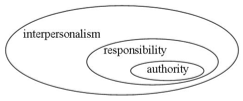
Deference and headship are correlative terms; they fall within a common larger category. The meaning of the first is implied by the meaning of the second and vice versa. To understand deference requires understanding headship. Since headship means responsibility, deference means cooperating with responsibility.
In the husband-wife relationship, because of the husband’s responsibility, the wife defers beyond what love already calls for mutually. Certain behaviors characterize that recognition. She does not pressure him into doing her bidding. She does not establish domicile when it is his responsibility to find work and provide for her and the children. On sensitive matters that affect them conjointly, she does not speak on her own outside the home or in front of the children. Beyond ways of acting that derive from personal relationship itself, any action is acceptable that fits with his final responsibility.
As an added note on the connotation of “submit,” we note Paul’s comment to the Corinthians about the household of Stephanas that had devoted themselves to ministering to the saints, “I urge you . . . to submit to suchmas and to everyonemas that helps and labors.” The context does not indicate that Stephanas was an elder in Corinth—which is possible, but Paul’s urging has to do with the household, a larger entity that reminds us of Isaiah’s wife as “prophetess.” In addition, Paul broadens the application to anyone that labors for the Lord, which introduces unofficial service into the scope of his reference.
Integrations
I. Headship as responsibility in an interpersonal setting shows how hierarchical (vs. egalitarian/equalitarian) marriage has nothing to do with the foreign items often mixed into the picture.
A. In regard to decision-making, responsibility does not eliminate a wife’s input, especially on matters that affect her, and most things affect her. It does not mean (1) making all final decisions or (2) making them to the husband’s preferences. Paul’s leadership as an apostle was not compromised because Apollos did not want to go to Corinth when Paul wrote his first epistle to that city (1 Corinthians 16:12). Responsibility does not suggest a husband’s (3) being in on every decision. Healthy marriages work out procedures the partners agree on, and both proceed with these principles without redeliberation. If headship does not involve these things, neither does deference. These points come from good leadership style. Not allowing input, etc., illustrates immaturity in headship, not headship.
B. Deference does not mean having a submissive personality. It does not mean that a wife cannot be an extrovert. It does not take away any effervescence natural to her. It means only that she does not run out ahead or try to take over in her outgoing tendency. Who does the most talking is a function of personality and verbal ability, not an indication of leadership. Not the amount of verbalizing, but the “weight” of it, is what demonstrates leadership. Weight comes from the power of ideas and placement of responsibility.
C. Headship and deference do not imply anything about ability, intelligence, and so on. Although scripture seems not to address the point, interpreters often suppose that God has gifted men and women in ways that correspond more closely with their overlapping responsibilities. The configuration of gifts and the differing degrees of shared gifts—which include most abilities—best equip men and women for their complementing roles. The distinctive emphasis of wife’s roles grows out of childrearing (1 Timothy 2:15). The distinctive emphasis of husband’s roles taking final responsibility for family needs like provisions and security (1 Timothy 5:8). The two roles are overlapping, corresponding gifting is by degree, and differences are statistical.
Scripture gives reasons for its directives on husband-wife relations:
1. in the creation man was first formed, then Eve (1 Timothy 2:13);
2. in the fall, the woman was deceived but the man was not (1 Timothy 2:14);
3. woman was created from man (1 Corinthians 11:8, 12a);
4. woman was created for man (1 Corinthians 11:9);
5. man is by woman (1 Corinthians 11:12b); and
6. women are weaker (evidently in a physical sense; 1 Peter 3:7).
The reasons are historical and constitutional, but New Testament writers do not spell out why historical reasons are, in fact, reasons or how the gifts of men and women differ to give rationale for a husband’s final responsibility.
D. Deference does not eliminate a wife’s thinking for herself. The teaching about headship does not remove anyone’s moral and religious self-responsibility.
E. Deference is not a feeling. Deference does not feel like deference when headship flows from love. It seems little different from the relationship in which it occurs. It “feels like” cooperation.
One problem in this subject lies in English vocabulary. Submission has come to connote “submissiveness,” which conjures up passive personality and low self-esteem. That is foreign to most women’s personalities and rightly so. “Submit” implies obedience under duress, one not born of free will. The fact that submission is commanded and that it is a matter of “submitting yourselves” (Ephesians 5:21) combine with the nature of proper leadership to eliminate any authoritarian element. Because of the connotation of “submit,” we have used defer for translating ὑποτάσσομαι (hypotassomai). Fear translates φόβος (phobos). In social contexts, respect better expresses our attitude toward Christ (Ephesians 5:21, e.g.) and a wife’s attitude toward her husband (Ephesians 5:33). It means respect for another’s worth and responsibility.
F. Similarly, deference has nothing to do with worth or anything that affects self-esteem. Self-worth derives from interpersonal matters, not from status—from self-giving vs. competition. Deference is for a purpose, not a person; deference does not comment on the worth of the one deferring or the one deferred to.
G. Deference comes from the motivation of respecting the fact that the other has a job to do. It compares favorably with the Hebrew writer’s admonition that his readers should obey their “rulers” in the church because those leaders must give account (13:17). Deference does not imply insincere cooperation to curry favor or appease power. That false view of submission corresponds with a false understanding of headship; it fails to make personal relationship the permeating factor.
II. Headship as responsibility in an interpersonal setting means that most things in marriage are not matters of leadership but of cooperation, preference, personality, expediency, and love.
The first thing in marriage, parenting, and eldership is not authority, but caring, because the first thing is personal relationship. Headship as responsibility in the context of love means letting love accomplish first as much as it can. At this level, marriage is equalitarian/egalitarian because most things in a marriage do not call for “leadership.” That is why equalitarian marriage sounds plausible, especially in contrast to abuses of headship, which are too common. Equalitarianism—at least interpersonal equalitarianism—embodies an important truth: love governs marriage like it governed courtship. It embodies an important half-truth, however, because there is more to marriage than personal relationship and certainly more than sheer individualism. Especially when children come into the home, family theory must suffice for family, and in some societies that goes beyond nuclear family to extended family. As the size of any group increases, complexity increases, and the need for some structure likewise increases. As long as a couple does not have children, the emphasis on headship is relatively low; love and influence take care of most everyday matters. Division of labor and sex-related roles come into operation more when husband and wife have children to care for. New Testament teaching about marriage and the home is calculated to guide complex family settings as well as the simple ones.
christir.org