
Five Models for Completely Reliable Scripture
FIVE MODELS FOR COMPLETELY RELIABLE SCRIPTURE
Virgil Warren, PhD
We do not need to decide between the “theories of inspiration” to understand how scripture came to have the character of “God-breathedness” (2 Timothy 3:16). As we can judge from scripture itself, God operated in more than one way in producing scripture. The models of origin may be organized according to what God specially gave to his human spokesmen.
1. God gave the words. Probably no one holds the dictation theory of inspiration strictly understood, even though people often suppose that Christians have that explanation for the origin of the Bible. It might apply to a few cases, notably the Ten Commandments, which in the first copy were written by the finger of God (Exodus 31:18; cp. also Daniel 5:25-28). In this format God operates in a significantly positive fashion (Daniel 5).
2. God gave the ideas. God revealed the concepts to the prophet through a variety of means. He may have implanted the ideas directly in the mind, but more normally we suppose that he told them as he did to Moses at the burning bush and elsewhere in Exodus when Moses entered the Tabernacle. When it came time for his spokesman to speak or write, the Spirit of God could prevent him from error in expressing what he had received. Though not dictating the words, God could operate restrictively to keep the prophet from erroneously expressing the ideas. In this way, we can speak of the “verbal inspiration” of the text. The Spirit acted positively in revelation and preventively in proclamation and inscripturation.
3. God gave the abilities. In this “dynamic inspiration,” the Spirit heightened the perception of the prophet rather than giving the words or ideas. Of course, heightened ability could also accompany ideas God may have revealed. The truthfulness of the prophet’s reproduction depended not only on being prevented from misexpression, but also on proper perception and recollection. Something of this sort seems apparent in John 14:26, when Jesus promised the disciples that the Holy Spirit would bring to their remembrance everything he had taught them. In this case as well, the content and verbal form of the record could be completely reliable so as to describe appropriately God’s own exhaled message. The Spirit acted positively in providing added abilities and preventively in helping to avoid error during the free exercise of those abilities. Solomon serves as a ready example of a man who was given special wisdom to lead God’s great people (1 Kings 3:4-15). His writings would express that inspiration.
4. God gave the experiences. From the experiences God caused or allowed, the prophet generated the content itself. The conversion of Cornelius illustrates this model. God gave Peter experiences (the vision, the command to accompany the Gentiles, etc.) in connection with which the apostle inferred one of the more significant doctrines in the New Testament. The text says he “perceived” (Acts 10:34-35) that Gentiles as such were acceptable to God. Several theological ramifications issue from this central point: Christianity was not a continuation within Judaism. Christianity did not represent a political, but a spiritual system, and so forth. From the way the record reads, we infer that God did not verbalize that precise point to the apostle. Peter himself generated the content, but through the Spirit’s preventive role the spoken (or written) product possessed verbal and conceptual correctness.
5. God gave the office. This model provides the most unstructured format from which verbal inspiration, infallibility, inerrancy of the message can derive. The prophet generates the concepts on the basis of his calling as a prophet and his understanding of God’s intentions through him. Nathan the prophet and David the king illustrate the construct. At first, Nathan confirmed David’s desire to erect a temple in Jerusalem: “Go, do everything that’s in your heart; Yahveh is with you” (2 Samuel 7:3). That night, however, Yahveh corrected the prophet without censure, telling him to return to David with the message that David’s seed would build the temple (2 Samuel 7:4-17). Nathan evidently supposed that, on the basis of his divine call to be prophet, those ideas that came to his sanctified mind accorded with the Lord’s will unless he stood corrected, which he did in this case. Since Nathan was serving as advisor to the king, his verdict here may represent advice more than commandment. At any rate, the message in its final form was accurate.
Paul apparently does a similar thing in 1 Corinthians 7:8-9, 12ff, 25ff, 40, where he gives “inspired advice” rather than express commandment. Some practical problems may be handled in more than one way. Specifying one way is accurate even though another option might be acceptable, especially for a different kind of situation elsewhere at a different time. Neither Nathan nor Paul “spoke presumptuously” (Deuteronomy 18:20) even though one of them stood corrected in one instance we know about. Under the Spirit’s preventive work, such pronouncements still possess the quality we call inspiration.
Verbal inspiration can result in more than one way. The formats described here appear in descending order according to the degree of special divine direction and in ascending order according to the degree of human initiative. God’s positive role diminishes, and his protective role increases as the human element increases. The positive role of the Spirit means what the Spirit initiates. The protective role means what man initiates and the Spirit ratifies or corrects. His correcting, protective, restrictive, preventive, permissive role applies both to words and content. Most cases appear to involve a combination of the five models and, therefore, of the positive and protective modes within them. One model need not fit all. But under both modes and any proportioning of them, the result is complete reliability.
Describing these five formats (a) clarifies how we can talk about totally accurate scripture without espousing dictation theory for originating it. Being aware of other models besides dictation (b) accounts nicely for the variety of structure, style, and content present in biblical writings. It fits with the fact that accuracy applies to the intended meaning rather than to forms of expression. It allows human creativity to express itself in divine service. Having additional formats in mind also (c) affirms the dignity of the human authors as persons. It sees the writing of scripture as an interpersonal process instead of a mechanical one. It removes the idea that producing an errorless text would prostitute the writers’ humanness. Conceptualizing a variety of formats (d) avoids overkill. We can apply to inscripturation the principle that God does not do for people what they can do for themselves.
Articulating a plurality of models (e) gives substance to the statement that “God-breathedness” (2 Timothy 3:16) specifies more the nature of the result (scripture) than the precise manner of the cause (inscripturation). Viewing the Bible as accurate in all matters whereof it speaks does not require any particular “theory of inspiration.” To say, for comparison’s sake, that God drove out the seven nations of Canaan does not require any format for his driving them out. The statement does not remove human effort by Israelite soldiers in conquering the land. It does mean at least that God guaranteed outcomes by making up for whatever the Israelites may have lacked in their ability to overthrow these nations on their own. Exodus 23:30-31 says, “. . . I will drive them out before you . . . you shall drive them out before you.” God guarantees what his special servants do. God is said to do what he only makes a decisive contribution to. God is even said to do what he allows (Job 1-2; cp. 42:11), including evil (Revelation 17:17). Understanding the point behind the expression “God-breathedness” needs to allow the biblical use of language to have the flexibility that the Bible uses.
Scripture has the character of what God himself would have expressed directly (“exhaled,” or breathed out). Understanding that expression requires only that God intervene to correct what human error might introduce. Otherwise, authors have free exercise of their creative powers. The concept does not remove human effort in producing the content; it only guarantees accuracy by making up for whatever the authors may have lacked in themselves. God’s correction could come in several ways, such as the one he used when Nathan misdirected David. Yahveh operated there in a largely preventive sense.
(f) Finally, in these five models there is always a supernatural element, which is what distinguishes special divine spokesmen from normal ones.
Our comments here do not argue for any specific view of scripture, and they are not calculated to do so. Rather, they describe processes applicable to more than one view. That variety of models applies to even the strictest concept of inspiration. Keeping them in mind removes distracting ideas that come up in discussions on the nature of scripture.
Summary Chart
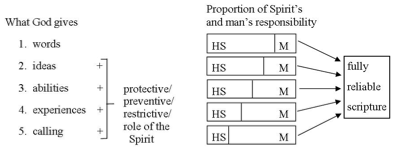
Inerrancy has to do with scripture ideally, or scripture as such.
Inerrancy has to do with the content of scripture.
Inerrancy has to do with the intended meaning of scripture.
God-breathedness/inspiration has to do with the results in scripture, not the manner of its
origin.
In regard to the Holy Spirit portion, there is positive supernatural activity;
in regard to the human portion, there is protective-restrictive supernatural activity.
christir.org