
The Relationship of General Revelation
THE RELATIONSHIP OF GENERAL REVELATION
TO THEISTIC PHILOSOPHY IN ROMANS 1-2
Virgil Warren, PhD
Introduction
Interpreters commonly take Romans 1:18ff as an instance where Paul lays out the theistic argument. Then they conclude that it is possible to establish the existence of the one infinite, true God and certain of his attributes.
This study proposes that Paul is not presenting an argument for God’s existence based on general revelation. Rather, he declares from special revelation the lostness of all people, against whom God’s wrath is revealed. Romans 1:18ff views collective humanity from the creation till the coming of the gospel. He presents (1) a collective anthropological viewpoint (2) in a revelational framework (3) from a total historical perspective.
Since people originally had special revelation about God, the most Paul intends in 1:20 is to say that general revelation was sufficient to confirm that original special revelation and to keep people from relinquishing the knowledge of God they had received originally. Humankind is corporately guilty, and then individually guilty because no person is no less a sinner than anyone else.
Whatever possibility there may be for establishing a theistic philosophy from general revelation, Paul does not set forth proof to that end, but to confirm the truth of the special revelation given originally, along the way, and now again in the gospel era.
I. Anthropological viewpoint of Romans 1-3
A. The usual view: pagan, moralists, Jews: 1:18-3:20
F. F. Bruce presents the common way of viewing Romans 1:18-3:20 when he outlines it under the heading Sin and Retribution: The Universal Need Diagnosed:
1. The pagan world (1:18-32)
2. The moralist (2:1-16)
3. The Jew (2:17-3:8)
4. All people found guilty (3:9-20).1
I. B. Grubbs handled the section in similar fashion under the heading Universal Need of the Salvation Offered in the Gospel Evinced from the Sinfulness of the Whole Race:
1. The moral condition of the Gentile World (1:18-32)
2. General considerations applicable alike to Jews and Gentiles, preparatory to
the special reference to the moral condition of the Jews (2:1-16)
3. Direct reference to the Jews embodying evidence of their sinfulness (2:17-29)
4. Comparison of Jews with Gentiles, showing the former to be superior as to privileges enjoyed, yet not as to their moral condition before the Law.2
Sanday and Headlam in the International Critical Commentary did the same, only in two steps rather than three.3 Most commentators approach the first section of Romans in this manner.
These commentators have in common the same perception of Paul’s movement of thought from 1:18-3:20. Using Bruce’s terminology, we may diagram the argument in this way.
pagans’ + moralists’ + Jews’ = universal
need need need need
B. The suggested view
F. F. Bruce said with respect to this portion of Romans, “Paul’s aim is to show that the whole of humanity is morally bankrupt, unable to claim a favorable verdict at the judgment bar of God, desperately in need of His mercy and pardon.”4 There can be no question that Bruce was correct in his analysis of the point that Paul is making in these three chapters, but the question is about the basis on which Paul makes that point.
While the usual outline is partially accurate, the text seems to require a different progression of thought by different diagram:
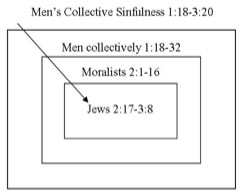
Under this arrangement Paul begins with people collectively (1:16) as the objects of God’s displeasure because of unrighteousness and ungodliness (1:18). Then he moves to moralists whether Jews or Greeks (2:10) who might claim exception to that characterization. Finally, he comes to Jews specifically (2:17ff) and removes all doubt as to whether they can claim exception. Under that pattern, chapter 3:9-20 is not a conclusion inductively reached, but a reaffirmation of Paul’s original proposition defended against objectors. He does not conclude that all people are separated from God because parallel parts of them are individually separated from him. Rather, on the basis of the universal call of the gospel (1:16-17), he affirms that everyone is separated from God and defends that proposition against any who seek exemption by claiming to be better than others. The “God’s righteousness” (1:17) revealed in the gospel is the concept—even the very expression—he returns to in 3:21ff.
The usual analysis of Romans 1-3 is inductive while the suggested one is deductive. Under the inductive approach Paul deals separately with pagans, moralists, and Jews under the theme of lostness because of sin. Under the deductive view he begins with the fact that all people, barbarians and Greeks (1:14), Greeks and Jews (1:16), need “God’s power to salvation” (1:16), “God’s righteousness” (1:17). What Paul declares in 1:18-32 Greeks and Jews would want to limit to barbarians; so, to discriminating Greeks and Jews he says beginning in 2:1, “You that judge other people are no better than they are.” Of Jews particularly he says, “You live inconsistently with the Law you believe and teach others” (2:21). Not even they can escape God’s displeasure.
(1) Jews that snub uncircumcised Gentiles are themselves “uncircumcised” because of transgression (2:25), so they are no better than the Greeks that did not receive the Law. It is not receiving the Law but doing it that makes people righteous (2:26-27, 12-15). So, Jews cannot claim superiority over Greeks. (2) Greeks in turn that claim to be “wise” and condemn foolish barbarians likewise condemn themselves with their own condemnation; they practice the same gross immorality and idolatry present among the most depraved barbarians. (Note the parallelism in 1:14: Greeks-barbarians, wise-foolish.)
1. Positive evidence from the text
The first evidence for the deductive arrangement comes from the text itself. Paul begins establishing the universal perspective as far back as 1:8 when he thanks God for the Romans’ faith as known throughout the world. In 1:13 he expresses his desire to have fruit among them, even as among the rest of the Gentiles. He is debtor to “Greeks and barbarians” (1:14). From the Jewish perspective “Jew and Greek” is a complete list (1:17). The gospel is then directed to all humanity as the power of God unto salvation, because the gospel reveals God’s righteousness to all people. If the gospel is the news of salvation for all people, then all people must need to be unsaved. If it reveals the righteousness of God that the righteous have by faith (1:17b), then all people are unrighteous in need of salvation. This fact of unrighteousness is declared (1:16-17), then described (1:18-32), then defended (2:1-3:20). Having established a universal perspective in 1:8-17, Paul announces that “God reveals his displeasure from heaven against everyone’s ungodliness and unrighteousness.” Everybody “sees heaven,” not just pagans.
2. Negative evidence from the text
Negatively the reader may observe that Paul nowhere says he is talking about “pagans”; he is talking about people. The unrighteousness by which they hinder the truth may vary in degree, but it is unrighteousness still.
3. Paul’s avowed revelation framework
What Paul writes in Romans 1-3 issues from a special revelation framework. A means of obtaining God’s righteousness has been revealed in the gospel; that is the good news. It is good news because it communicates something everybody needs to know: there is salvation now. Salvation for everybody implies the lostness of everybody otherwise.
Paul himself would not have known that all people are lost had it not been for the special revelation in the gospel. He had previously thought that people could save themselves by keeping the Law. When the gospel came, it showed that such was not the case, but that everyone is a sinner and therefore lost. Not only, then, does the Roman epistle begin with a deductive framework by reference to the gospel, but Paul’s whole life was a deductive result of special revelation. Since Paul begins with a revelational framework, he deals with a deductive matter, and the content of that revelation involves precisely the fact that everyone is lost; otherwise, not everyone would need the salvation that gospel revelation announces.
4. The blurring of categories
Another observation that supports the suggested arrangement of thought is the blurring of categories between pagans, moralists, and Jews. Under an inductive pattern we would not expect such a phenomenon, but it fits with a pattern of narrowing categories. (a) While talking about all people (large square), a presenter may mention something peculiar to Jews because Jews (small square) are a part of all people. While talking generally about
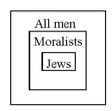
moralists (intermediate square), Paul may speak of Jews, who are included among them. (b) Conversely, while dealing with the inner squares, one would not speak of something from which they are exempt. (c) Thirdly, the transition from larger to smaller squares can be more blurred, and there may be a wavering back and forth as the author moves toward a more restricted reference. The reason is that the edge of the moralist square is, so to speak, superposed over the all-people square.
The blurring of these categories appears in the fact that some of the sins listed in 1:18-32 were committed by moralists and Jews as well as barbarians. In such instances, the reader’s mind moves to the center of the large box, which is also within the box for Jews and moralists. The point of the sin list becomes this: some sins are common to everybody while others are limited to some, but the definition of sinners does not depend on how many sins they have committed, which ones, gross or not so gross. Sinners are sinners because they have sinned.
Sexual immorality (1:26) was not peculiar to pagans; neither was covetousness, envy, deceit (1:29), boasting (1:30), lack of mercy (1:31). On the other hand, covenant breaking is more connected with Jews than pagans. So, pagans are not the only ones condemned in 1:18-32; all people come under God’s displeasure.
5. The historical perspective
The historical perspective that the next section handles, also makes it evident that there is no basic distinction between Jews and Gentiles from a collective viewpoint, because the Jews’ ancestor Abraham came out of an idolatrous pagan situation (Joshua 24:2) to become father of the faithful.
B. Relationship to the question of theistic philosophy
If Paul’s anthropological viewpoint is collective rather than individual as he begins in 1:18, his approach is deductive rather than inductive. Since his approach is revelational (1:16-17), it is also deductive. If his approach is deductive, it is not primarily philosophical but revelational. Paul does not first establish a natural theology and put a revealed theology on top of it. Rather, he begins with the revelation that everyone needs the salvation proffered in the gospel and describes the character of lost people as evidenced by their deeds, defending that proposition against disclaimers by showing that they are basically no different than the people they contrast themselves to.
II. Historical perspective
A. The general pattern
A second matter of importance is that Romans 1:18ff stands in a historical framework that briefly recapitulates the whole history of God’s dealing with people and the general pattern of recurring apostasy among them collectively. Paul is not speaking of a characteristic process that goes on in individuals at any time, but of the process that has occurred during the whole history of people collectively after special revelation was given in the beginning and repeatedly thereafter.
There are several aorist verbs in 1:18-32 that form a historical sequence in the past. Paul does not use a series of timeless present indicatives as if speaking of a characteristic recurring process with each individual. In 1:19 “God manifested it to them”; in 1:21 “having known God, they did not glorify him as God but became vain”; “they became fools” and “changed the glory of God into a likeness. . . .” So, God gave them up to uncleanness to dishonor their bodies (1:24-25), to vile passions contrary to nature (1:26-27), to a reprobate mind to do things that are not fitting (1:28-32).
As a historical pattern, then, Paul begins in the present: the righteousness of God is being revealed in the gospel (1:16-17). He passes to a timeless recurring pattern: God continually reveals his displeasure from heaven against unrighteousness; the knowledge of God is constantly manifest among humankind; the invisible things about him are always clearly seen. He moves to the past: they knew God; they did not glorify him as God; they became vain, foolish, and darkened; they changed the glory of God; they refused to have him in their knowledge; God gave them up. Finally, he returns to the present: they know the ordinance of God; they sin; they consent to sin (1:32-2:1ff).
B. Presence of an original special revelation
God gave special revelation in the beginning. The Old Testament records that fact. Since Romans 1:18-32 is a historical summary of mankind’s collective apostasy from the time of creation and their being given up by God subsequently, the interpreter is justified in prefixing revelation to humankind’s general apostasy of which Paul speaks. As a matter of history, God did deal with people directly in the beginning before their defection.
We need not bring that fact to the passage, because Romans 1:21 refers to that original special revelation, “They knew God”; in 1:25 they exchanged that truth about him for a lie; 1:28 says they refused to have God in their knowledge. Of course, we might interpret that knowledge and truth about God—which they refused to keep—as a knowledge of his eternal power and deity (1:20) and incorruptibleness (1:23) as perceived solely from what God made (1:20). It would be a knowledge that could have caused them to glorify him, be thankful (1:2), and worship him (1:25).
But Paul seems to be thinking along another line. “The invisible things of him . . . are clearly seen . . . that they may be without excuse . . . because . . . they became vain in their reasonings . . . ” (1:21-22). Paul’s core statement is that their knowledge of God from general revelation was sufficient to make them without excuse for becoming vain in their reasonings. His point is the very reverse of being without excuse for not leaving their vain reasonings, for not enlightening their senseless heart, for not leaving their foolishness, for not exchanging the likeness of an image for the glory of the incorruptible God. Instead, they were without excuse for exchanging the truth of God for a falsehood, for refusing to have God in their knowledge, for becoming vain, darkened, foolish, and idolatrous. General revelation made them without excuse for leaving the special revelation God had given them.
The people Paul speaks about were not originally vain, foolish, darkened, ignorant idolaters. They knew better at first. Paul does not specify that their originally knowing better came from general revelation. God did not continually reinforce the original revelation by his personal presence with every person or with every generation after Adam went out from his presence. The descendants of earliest people turned aside from their knowledge of God originally given, passed down in race remembrance, and confirmed by the world around them. General revelation was clear enough that these people should not have supposed that some other view of God was better than the one they had received. Nature is easier to explain in terms of the God they had known than in terms of what they substituted for him. Confirmatory evidence in a revelational deductive framework greatly differs from primary proof in an empirical inductive framework. Paul refers to the former and leaves the possibility of the latter untouched in this context.
In light of Paul’s point that the created things sufficed for keeping people from becoming vain, the manifestation meant in 1:19b is special revelation. “To make manifest” refers to special revelation in other passages. Romans 3:21 is especially to the point, “But now apart from the Law a righteousness of God has been manifested, being witnessed to by the Law and the prophets.” Since 3:21 returns to the thought of 1:17, no difference of meaning exists between φανερόω (phaneroō, “manifest”) in 3:21 and ἀποκαλύπτω (apokalyptō, “reveal”) in 1:17.
In 1:19a what is it, then, that is manifest among humankind? “The known about God” that is “manifest among people” refers to the awareness of God that they manifest even in their perverted worship. Pagan idolatry, though a perversion of God’s real nature, witnesses to the fact that “deity” is something everyone knows about. There is no knowledge more universally manifest than the concept of deity (1:19a). The reason is that God personally manifested himself to people in the beginning (1:19b).
The knowledge of God is manifest among people because God manifested it to them. Manifested is aorist indicative, not continuous action; so the word is better suited to special revelation than to general revelation (continuous action). The text does not say that the knowledge of God is manifest among people because God manifests it to them through general revelation; because general revelation is continuous everywhere.5
Furthermore, Paul says, “the knowledge of God is manifest” (φανερόν ἐστιν, phaneron estin). He does not say, “the knowledge of God is (being) manifested” (φανεροῦται, phaneroutai). The knowledge of God is obvious among people in their behavior, not that the knowledge of God is being manifested to them (in general revelation). The whole of 1:19 means that people’s knowledge about God is obvious from the way they live. Something so obvious now originally resulted from special manifestation by God in the past. If that manifestation occurred at a certain time, then it stands in contrast to another time or to a continuous process. If so, Paul is referring to original special revelation rather than to continuing general revelation.
If this construction captures Paul’s meaning in 1:19, then Paul himself appeals to special revelation rather than to general revelation as the first explanation for the manifest knowledge of God among people. Having appealed first to special revelation for that explanation, Paul can be appealing to general revelation in 1:20 only as confirmatory evidence. His point in the appeal says nothing about the possibility of constructing an argument for the existence of the one true God from the data of general revelation alone.
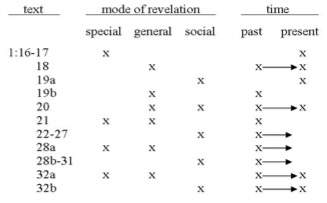
The whole of 1:18-32 may be put together as follows. In the present time, special revelation in the gospel declares the righteousness of God, the sinfulness of people, and the means of reconciling them to God (1:16-17). Whereas special revelation always reveals God’s righteousness,6 general revelation reveals especially God’s power and that continuously (1:20). Social revelation7 reveals particularly God’s displeasure (1:18).8 The manifest knowledge of God among people even in its perverted form witnesses to an original disclosure of God’s nature in special revelation. General revelation in nature has surrounded people with confirmatory evidence that should have kept them from turning aside to less adequate views of God than they originally had (1:19-20). So, knowing God from special revelation conformable to general revelation, people had no excuse for their apostasy and so God gave them up. The following diagram summarizes the description.9
B. Relationship to theistic philosophy
The central point of Romans 1:20-21 is that the “made things” render people inexcusable for becoming vain. Such a use of general revelation differs from constructing a theistic proof since it appeals to the creation to confirm what people had known through special revelation before they became vain. Theistic philosophy is based on general revelation alone.
Conclusion
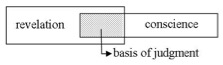
What view we take of Romans 1 must contribute to the conclusion that all have sinned (3:23). Paul characterizes the human race historically as having turned from the true knowledge of God they had originally (chapter 1) and defends that characterization against anyone who would claim exception (chapter 2). So, in chapter 2 those who come on the scene after the apostasy, Paul condemns for inconsistency between behavior and (1) conscience or (2) revelation depending on whether the individual is a pagan or Jew. No individual in the present situation can claim exception to the lost condition of people collectively, the historical explanation of which eventuation Paul traces in Romans 1 from the beginning to the present. Anyone along the way who has drifted from special revelation stands condemned on the same principle as those who originally did so.
The Christian framework is deductive because special revelation has taken place. A non-revelation framework is limited to induction. In light of Romans 1, we suggest then, that Paul’s opposition to reason in other portions of his writings is not (1) because reason should not be used, or (2) that the use of reason conflicts with subservience to God, or (3) that revelation is not reasonable or rational, or (4) that reason is incapable of establishing the existence of one infinite, good God. While reason might be able to establish a true knowledge of God—albeit quite limited, reason establishes an inadequate true knowledge of him and so is aside from Paul’s purposes as a missionary of the good news about salvation from sin.
The plight of people without revelation is not necessarily (1) that they lack the capacity to construct a valid argument for the existence of the one true infinite good God or (2) that they are ontically incapable of appreciating, assenting, or actively committing themselves to the fact established by rational empiricism.
Other reasons hinder this: (1) lack of motivation to construct an argument that puts the center of attention outside themselves and (2) the willful refusal to accept what is true because of its implications. The complexity of the argument affords many opportunities to question, to suggest other possibilities, to be irrational.
The problem for people without revelation is that they do not have the proper conclusion before they begin; so they have no way of knowing that their conclusion is wrong when they get to it. After they have constructed their own argument from their own facts and have arrived at their own conclusion, they are as unwilling as Christians are to give up that conclusion. They believe it is true even when they see the contrasting proper conclusion and the argument is laid out for them. Being defensive of their own view, they do not focus their attention on what a theistic philosopher is saying. They fix half of their attention on constructing a rebuttal. They feel that they and God’s spokesmen are on equal footing and that they themselves are as capable of discovering truth as anyone else. The difficulty does not lie in the ability to manipulate rationally the facts common to both them and the theist. The problem is that they lack the theist’s guidelines for putting them on the correct path. The reason theists can get to the conclusion is that they know what it is. The difference between “revelation people” and pagans is the revelation that Christians have; but in constructing theistic philosophy, the whole point is to do it without the aid of revelation, which puts a Christian back on common ground with the pagan. To operate otherwise is to change the process from philosophy to theology, from general revelation to special revelation.
Three possibilities exist for theistic philosophy and the use of general revelation in Romans 1. (1) From general revelation it is possible to construct a true, albeit inadequate, quite limited, theistic philosophy. (2) From general revelation it is possible to confirm special revelation, but not to establish theism on general revelation as primary proof. (3) While it may be possible to construct a true, but inadequate, quite limited, theistic philosophy from general revelation as primary proof, it is not Paul’s intention to do so in Romans 1. This study has chosen the third alternative because it represents the least truth claim.
End Notes
1F. F. Bruce, The Epistle of Paul to the Romans: An Introduction and Commentary. Vol. VI of the Tyndale New Testament Commentaries, edited by R. V. G. Tasker (Grand Rapids, Michigan: Wm. B. Eerdmans Publishing Company, 1963), pp. 81-102.
2Isaiah Boone Grubbs, An Exegetical and Analytical Commentary on Paul’s Epistle to the Romans (Nashville, Tennessee: Gospel Advocate Company, n.d.), pp. 39-58.
3William Sanday and Arthur C. Headlam, A Critical and Exegetical Commentary on the Epistle to the Romans in The International Critical Commentary (New York: Charles Scribner’s Sons, 1911), pp. 39-81.
4Ibid., pp. 81-82.
5Ἐφανέρωσεν could be an ingressive aorist signifying the beginning of continuous general revelation, but that possibility does not seem likely since the next verses use present tenses rather than ingressive aorists.
6The righteousness of God was revealed in the original special revelation in the fact that God judged the sins of Adam, Eve, and Cain.
7“Social revelation” here refers to the recompenses God decrees on those who turn from him: he “gives them up.” While social disorder and strife could be considered part of general revelation, it is here made a separate category from special revelation through direct means and from general revelation indirectly through nature. Since people are not a part of impersonal nature, revelation “through people” differs from revelation through nature. Distinguishing a third mode of revelation seems helpful for conceptualizing the gamut of God’s means for making himself known.
8Every religion by some system of sacrifice, appeasement, and the like, implies people’s gnawing dread of estrangement from God and a desire to be in favor with him.
9As regards people who lived after the apostasy had occurred and therefore had no access to unperverted special revelation, Paul says that God overlooks it (Acts 17:30; cp. Acts 14:16) and judges them by consistency between the way they live and their conscience where it is leading them in conformity with a revelation they no longer have (Romans 2:12-16). Special revelation is now coming again, and people are to repent (Acts 17:30-31).
christir.org