
The Sabbath, the Lord's Day, and the Christian
THE SABBATH, THE LORD’S DAY, AND THE CHRISTIAN
Virgil Warren, PhD
Introduction
Sabbath observance corresponds with national Israel. God instituted the Sabbath as a memorial of the exodus because Israel became a nation at the exodus. Sabbath observance does not apply to those outside of Israel, before Israel, or after Israel, hence, not to Christians.
The agenda for Sabbatarians has been to show that the Sabbath applied outside of Israel. It was supposedly observed before Israel, outside of Israel, and after Israel because it was a memorial of the creation, an ever-relevant event to memorialize.
I. Why Christians Remember Sunday
The expression “the Lord’s Day” in Revelation 1:10 shows that by the time John wrote Revelation, a specific day had gained enough prominence to be called his day. The day when Christians normally met for worship would be the day previous observations identified as the first day of the week.
A. Christ’s resurrection occurred on Sunday (note Matthew 28:1).
B. Many of Jesus’ appearances took place on Sunday (Luke 24:13ff; John 20:11ff).
C. The church was established on Sunday (Leviticus 23:15-21 re Pentecost).
D. The practice of early Christians was to meet on Sunday (1 Corinthians 16:1; 11:17ff; Acts 20:7).
Sunday is different from the Sabbath day, when Jews gathered for worship; the earliest Christians were Jews. These two points show an intentional difference between day seven and day one.
E. The triumphal entry evidently happened on Sunday.
II. Arguments Against the Christian Observance of the Old Testament Sabbath
A. New Testament objection: “Don’t let anyone judge you about food . . . or Sabbath day, which are shadow of things to come” (Colossians 2:16-17).
B. No basis for the Christian practice
1. Sabbatarians think of the Sabbath as memorializing creation so that it applies to all generations everywhere throughout history. Three texts do connect the Sabbath with God’s creation rest: Genesis 2:3, noted above; Exodus 20:11; and 31:17. These passages, however, do not connect Sabbath with creation as a memorial of the creation. The manner of observance is the reason these texts connect it with the creation: a weekly rest on the seventh day. The meaning of the Sabbath comes from its connection with the exodus, the “Independence Day” for national Israel (Deuteronomy 5:15; Exodus 13). Participants were to “remember” that founding day.
So there is no adequate positive evidence from the creation account for
connecting Sabbath observance with creation and so with all humanity permanently.
For comments against the invalidity of the “memorial of creation” view,
see “The Sabbath as a Memorial of the Exodus.”
2. Invalidity of the “pre-Israel” argument
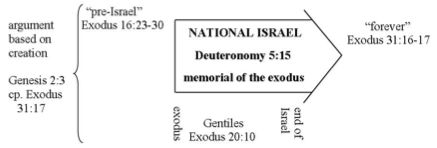
a. Genesis 2:3 appears at a place in Genesis before the founding of Israel, but it does not refer to a time before the founding of Israel. The placement of the comment about God’s hallowing the seventh day is to be distinguished from the time when the Sabbath was to begin being observed. The Genesis comment is not a command to observe the Sabbath then but an explanation about observing it on that day. Moses is writing here from the time viewpoint of the exodus from Egypt. For his contemporaries, he inserts a comment about Sabbath at the point where he records the event that served as the pattern for observing it. The memorial of the exodus from slavery was analogous to God’s earlier rest from his creation work.
Furthermore, Genesis 2:3 does not say that God blessed the Sabbath day and hallowed it; it says he blessed the seventh day and hallowed it. Reading the verse should stress the word seventh in contrast to other days of the week. Moses’ comment explains why God used the seventh day as the exodus memorial, why it was weekly rather than annual, together with observing it as a rest instead of a celebration or feast. Genesis 2:3 says that God blessed the seventh day, but Exodus 20:11 says that God blessed the Sabbath day. The point evidently is that, having identified the seventh day as the rest day, Moses can later call it a “Sabbath day,” a rest day.
Genesis 2:3 deals with the placement of explanation rather than the time of initial observance, and it gives an explanation about form rather than meaning. We do not need to take it as evidence that people observed the Sabbath from the creation onward. Indeed, there is no example of such an observance before the exodus.
b. Exodus 16:23-30 is before the giving of the Law, but after the beginning of Israel as a nation. The constitution of Israel as a nation technically occurred at the crossing of the Red Sea, where, by leaving Egypt, they became a separate nation from the one where they were a subdivision, a slave class (1 Corinthians 10:2: “baptized to Moses in the cloud and the sea”).
3. Invalidity of the Gentile approach (Exodus 20:10)
Gentiles present in Palestine were to observe the holidays in keeping with Jewish regulations. The Sabbath law never applied to Gentiles elsewhere. The Sabbath was a sign between Israel and God (Exodus 20:10; 31:12-17). Those living among the Jews were to observe the holidays along with the native population. That is a different thing from Gentiles as Gentiles being called on to observe the Sabbath in foreign territories.
4. Invalidity of the “forever” approach
a. Forever is a “universal” word and as such lies within the frame of reference where it stands (Exodus 31:16-17).
b. Examples: slave legislation (Exodus 21:6); slaves serve “forever” (Philemon 15). See What the Bible Says About Salvation, pp. 125-26.
The following diagram summarizes the argument for universal observance of the Sabbath throughout history.
C. After Pentecost, A.D. 30, no one commended, commanded, or practiced the Sabbath as a Christian observance.
Rest is appropriate for everyone. It gives a psychological break and allows people to balance purpose/goal orientation with existential relationship vertically and horizontally. Having a break from routine—even a regular set break for a whole day every week—is a different thing from infusing that “day off” with a religious significance like memorializing the creation, the exodus, or the resurrection of Christ.
Cessation from labor is associated with God, who rested from creation (Genesis 2:3); with Israel, who rested from Egyptian slavery (Deuteronomy 5:15); and Christians, who rest from this life’s labors and trials (Hebrews 3 < Psalm 95).
III. Argument Against Christians Observing Sunday After the Manner of a Rest
A. No precedent for observing the Lord’s Day after that fashion
B. No commandment to do so
C. Not governed by the same minutia of legislation as Sabbath was (and people
advocating the Sabbath-Sunday correlation so observe it)
1. Death for desecration: Numbers 15:32-36; Exodus 31:4
2. Extreme “no-work” clauses: fire-building was prohibited (Exodus 35:3), baking also (Exodus 16:23); people were to stay home (Numbers 16:29). The prohibition against building fires meant needing to eat “leftovers” and not cooking meals on Saturday. Those provisions gave women a break as well as men, who worked in the fields, with the herds, in business, and in other labors outside the home.
D. Sunday and Sabbath memorialize different things.
1. The Sabbath memorializes the exodus, the beginning of national Israel (Deuteronomy 5:15).
If the Sabbath was a memorial of the exodus (Deuteronomy 5:15), it was not observed prior to what it memorialized. If it was a memorial of the exodus, any observance after the exodus would not qualify as a pre-Israel or Gentile observance. As Paul notes in 1 Corinthians 10:1-2, Israel became a nation at the exodus, not at the giving of the Law a few months later. Israel became a separate national identity at the Red Sea, not at Sinai. At the border of Egypt, Israel ceased being a slave class in another nation.
2. The Lord’s Day memorializes the resurrection (perhaps also Pentecost, the beginning of the church).
Sabbath pertains to national Israel. So, it is not observed outside, before, or after national Israel. That generalization implies the lack of validity for arguments before Israel based Genesis 2:3 and the pre-Israel argument from Exodus 16, for arguments outside Israel based on Gentile observance in the land of Israel, and for arguments after Israel based on Sabbath as a memorial to creation and based on the “forever” argument.
christir.org