
A Teaching Methodology Combining Apologetics
A TEACHING METHODOLOGY COMBINING APOLOGETICS
WITH PERSONAL GROWTH AND WITNESSING
Virgil Warren, PhD
INTRODUCTION
“Apologetics” deals with multiple components that combine in produce faith and growth in it. The conviction is that the structure of apologetics correlates with the process of evangelism and the pattern of personal growth. Evangelism looks at this matter from the standpoint of the communicator and sees it as communication; apologetics looks at it from the viewpoint of the hearer and experiences it as conversion; personal growth looks at it from the perspective of a believer and realizes it more and more as sanctification. What is seen, however, is the same thing. The accompanying diagram depicts the structure of the process.
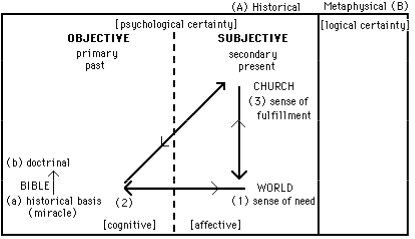
ELEMENTS OF THE PROCESS
Need
The first given of the human condition is our dependent position in the world. The feeling comes from what we can consider “the sense of dependence.” Our status in reality forces us to reach out for security amidst limitation, flux, and threat. Scripture shows that a more ideal circumstance has been withdrawn from our human experience—evidently for the purpose of bringing greater awareness of dependence because disobedience occasioned the withdrawal. Special limitations were calculated to return us to God, i.e., to have apologetic force.
A second given of humanness is a drive for meaningfulness. From dependence comes a crisis of meaning for us both subjectively and objectively. Meaninglessness leads to suicide. We do not ask why that is so; it simply is. If we become convinced that we mean nothing to anybody, we cannot bear to live. What ending life has to do with being insignificant remains unclear unless it assumes reason-to-be.
A third given in human nature is a need for a sense of innocence. Guilt serves as one of the most destructive forces within us. The importance of a “clear conscience” is illustrated by the number of mechanisms for coping with a bad one: withdrawal, hardheartedness, displacement, deception, self-punishment, rationalization, compensation, and forgiveness. A life of guilt repels us from life itself.
A fourth given of human nature is a desire to be loved. Alienation, the natural consequence of wrongdoing or self-centered behavior, brings psychological “pain.” Even loneliness saps the vitality and radiance out of nearly every personality. The sense of acceptance in human relationships makes noticeable change in our demeanor and behavior. A better self-concept through interpersonal acceptance relates to meaningfulness since love provides a sense of worth (1 Corinthians 13:1-3).
Basis
The foundation of Christianity lies in history more than in ideas; Christianity is historically grounded more than philosophically based. Objectively, in chronological order, the originating bases for the Christian faith lie beneath the distinctive events on which the faith rests. (a) The “Christ event” follows in the train of a long history of God’s dealing with the Jewish people among whom Messiah arose. Since Jesus Messiah carries forward that history and fulfills its anticipations, the evidential value attached to that history accrues to Christianity as well.
Similarly, (b) various aspects of the Christ event have their own directly authenticating marks, including miracle, so that Messiah’s coming can stand independent of the preceding history that serves to enhance it.
Finally, (c) subsequent events in the Christian era tend to show that Jesus’ original Jewish opponents erred regarding him. The dictum “Messiah abides forever” (John 12:34), argues for the truth about the resurrection that in turn validates the church’s existence (Acts 5:33-39).
The meaning of Jesus’ death-resurrection becomes clear both through it and in connection with it. His experience on the middle cross differed from that of the men beside him, not only because of the life he brought to Calvary and the manner in which he died there (Mark 15:39), but because of the resurrection that in effect “powerfully declared him to be the Son of God” (Romans 1:4). Before, during, and afterward, miraculously attested proclamation made known the meaning in the Christ event itself.
Use
Practical things are true only if they work; “the proof of the pudding is the eating.” The abundant life available through the gospel confirms the truthfulness of what produced that life. As a result, the productive use of the gospel in Christ’s body the church serves also as an aspect of the full apologetic for it.
OPERATION OF THE PROCESS
General Flow
From the functional standpoint, apologetics begins in the present with the subjective sense of need, a sense engendered by events that transpire in human experience and by the love of God’s beloved. (1) The correlation between personal need and gospel content means that the good news is not academic; hence, need creates a tendency toward favorably hearing the answer.
(2) The gospel’s internal consistency combines with the initial recognition of its correlation with human need to propel us into Christian living. (3) In turn, experiencing the fruit of righteousness causes a re-assessment of need, which brings improved understanding of what scripture means about various matters it addresses. Somewhere in that process conviction becomes strong enough that we make commitment to Jesus Christ as Lord of life and savior from sin.
Reciprocal Character
The schematic pictures a pattern distinct from that of other causal series like straight-line causation or thesis-antithesis-synthesis. Reciprocation involves two or more “poles” that operate back and forth on each other. So, the process can start with any of three positions in the “apologetic triangle,” and it can run backwards or forwards. Out of that pattern comes the growth potential that by degrees approaches certain crisis occasions like initial conversion, commitment to “specialized vocational ministry,” or the conquest of some besetting sin. The “degrees” here are degrees of the same thing in sanctification: greater and greater conviction, commitment, and correction in regard to Christ and his value system. Reciprocation gives increased power through inter-operation and growth potential through degrees.
APPLICATION OF THE PROCESS
Apologetics
Since the format above deals with objective historical basis and subjective application, the process does not so much defend Christianity itself as it commends the faith for what it is to us for who we are. “When plugged in,” the three “stations” in the system becomes a combination that functions with more power than any one station. Furthermore, that combinationalism functions by degrees so that explains why conversions may not be instantaneous.
Evangelism
When we present the gospel, we do well to keep track of where we are, where we need yet to go, and where the listener is coming from. If these factors describe the faith itself and those needing to accept it, then the process automatically is the one to use in evangelism. Consciously, employing it should increase effectiveness.
Sanctification
Growth in conviction about the truth of Christ and in the quality of life with Christ involves the same components that belong to apologetics and evangelism: felt needs, the biblical message, and resultant response (note Colossians 1:9-11; 2 Peter 1:5-8). To be sure, other aspects of sanctification function along with (a) need-answer-use, namely, (b) inner-outer reciprocation and (c) interpersonal reciprocation. Nevertheless, inasfar as personal growth participates in the operation, recognizing that fact maximizes its contribution to our continued personal growth.
SUGGESTIONS FOR TEACHING METHODOLOGY
“Integration” is the name of this endeavor. Fragmented learning may come from such a simple thing as giving related courses separate listings in a college curriculum. A degree program may place two or three years between related studies. Different faculty members may understand some matters differently; we may be unfamiliar with each other’s approach; or we may not know enough about other subjects to see correlations. Several elements in the education circumstance can serve to combat fragmentation.
A Professor’s Example
Teaching is demonstration even more than verbalization. Striving for our own grasp of a unified field of knowledge models the need for life-wholeness in ministry. The work for which Christian college students prepare calls for life improvement; therefore, they need to grow; so we should be growing and showing how sanctification occurs. Ministry calls for holism; consequently, we must grow beyond our specializations; in the process, we can reduce complexity by calling attention to unity of disciplines. As an indication of genuineness, that endeavor goes on as surely outside class as in it.
Class Time
Writing class notes in full frees up class time for practical application. Besides, printed materials are more organized, complete, and clear than sketchy notes that have low retrieval value later in ministry. Class members can read lectures ahead of time with a view to requesting clarification if needed.
A certain amount of class time can include discussing realistic witnessing situations and the mechanics of personal growth. When apologetics teachers take time for such topics, they communicate the fact that those applications are as important as what the professors are there primarily to teach. It shows that something useful is going on. Especially with adults, learning something occurs when there is a need to know it; so motivation to learn is better if there is obvious usefulness. “Education for use” presses beyond the liberal arts philosophy of education and adds the missionary purpose of the church for which Christian colleges prepare servants. Outreach usefulness and personal application help get rid of the rite-of-passage syndrome that can stand as negative factors in the higher education model for ministry preparation. Verbalizing concern for growth and outreach helps keep these issues before the hearers’ minds as they work out the more factual aspects of college work.
Joint Structuring of Courses
All courses related to apologetics, evangelism, and sanctification can be deliberately connected with the same schematic. Apologetics, personal evangelism, and Basic Christianity cover these topics. In addition, we can “locate” Critical Introduction to the New Testament and the Old Testament in the larger apologetic framework. For example, the three important principles of canonicity—historical, doctrinal, and subjective—correlate with 2a, 2b, and 1+3 respectively in the diagram. Pointing out such relationships fosters cohesiveness in a student’s course of study.
If the same professor teaches three of the courses mentioned above, it is relatively easy to highlight the transfer between them. When different teachers offer them, special efforts at co-ordination are necessary. It is expecting a lot to hope that several instructors could agree on, say, our proposed format; but if it can happen, it offsets the ill effects of fragmentation. Students bear responsibility for integration, but they need assistance in that aspect of education as much as they do in any other.
Assignments
With a little creativity, we can describe realistic situations that call for using information class members are studying at the time. They can redeem evangelistic opportunities by using the schematic and reporting on the experience. The amount of time and energy for such pursuits call for careful planning, but mixing in even a modest emphasis on practical application can flavor the learning with realism.
Tests
Tests are perhaps most difficult to align with the integrative concern. Nevertheless, take-home tests might be prepared with open notes and resources for answering application questions. In-class examinations can include an honor question or two in order to measure how well students understand what they are learning and to give them opportunities to connect information studied with problems posed. Students have a tendency, for example, to associate a certain cluster of facts with certain terminology, so they fail to recall that information when the “call words” are absent. Knowing ahead of time that real-life problems will be on the test should encourage participants to understand realities, not memorize words.
The teaching methodology for apologetics, personal growth, and witnessing rests primarily in the dynamic model of apologetics diagrammed at the outset. It inserts human factors into the structure of Christian evidences so that operations like evangelism and sanctification can integrate more easily. The suggestion merits reflection and actual testing in Christian college curriculum.
Based on a presentation at the Annual Meeting of the AABC; October 27, 1983
christir.org