
Divine Guidance
DIVINE GUIDANCE
Virgil Warren, PhD
The relationship we have with God is interpersonal, but God is the leading person. By creation and redemption, he has established his concern for us and won the right to speak to us for our own good and his glory. We should study his guidance of us because if we misunderstand it, we make ourselves liable to guilt, misdirection, and false doctrine.
I. WAYS GOD GUIDES
A. Special ways God has guided
1. Examples
a. Moses (Exodus 3:1ff.)
b. Gideon (Judges 6:11-25ff.)
c. Jeremiah (1:1-2:1)
d. Joseph (Matthew 1:19-25)
e. Mary (Luke 1:26-38)
f. Paul (Acts 9:1-19; 16:9-10)
g. Philip (Acts 8:26-40)
h. Peter (Acts 10:1-11:8)
2. Observations
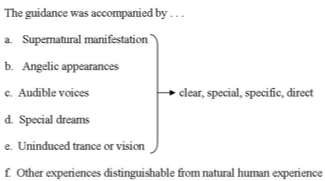
All the examples of calling and directing were clear and objective and should not be likened to vague “urgings” people are sometimes encouraged to follow. Ideas that cross the mind are not the same as revelation; feelings that well up within us are not signs. They may be good and true, but we do not want to confuse our ideas and feelings with divine indications of what we are supposed to think or do.
3. Expectancy: how much special guidance is normal?
a. Scripture is a record of special acts of God.
b. Observations balancing the special callings
(1) *1 Samuel 3:1b: “precious”
(2) Malachi to John the Baptist: “no exact succession of prophets”
(3) Elijah and some of the prophets, but 7,000 had not bowed the knee to Baal (1 Kings 19:18)
(4) The apostles/prophets, but many scattered (Acts 8:1b-4; 11:20-26)
c. Our own Christian experience does not well support direct, knowable, specific leading at each juncture.
B. Normal ways God guides
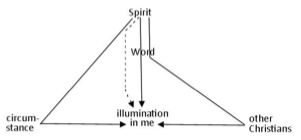
1. Bible: activated by reading
a. Basic commandments
b. Doctrinal truths
c. General values and goals of God in the world
2. Other Christians: activated by fellowship
a. Aid us in understanding scripture and evaluating ourselves and
circumstances.
b. Aid us in practical use of the biblical truth in given situations of our
own day.
3. Circumstances: activated by prayer
Much answered prayer flows through this avenue.
4. Presence: activated by communion, meditation, and prayer
a. Thomas Chisholm’s “Great Is Thy Faithfulness”: “Thy own dear
presence to cheer and to guide”
b. Parents around children: Walk the child to school the first day
c. Not just negative restraints, but positive encouragement
II. IMPORTANT VARIABLE IN DIVINE GUIDANCE
A. (Cognitive) content and (affective) motivation
Content comes from the Bible; motivation comes from the other avenues of
guidance.
B. Revelation and guidance
Revelation comes from the Bible; guidance comes from the other avenues of
guidance.
C. Known and unknown guidance
Circumstances especially amount to an unknown factor.
D. Direct and indirect operation
Notice that the solid lines equal the direct while the dashed line equals the
invisible and direct.
E. General and specific will
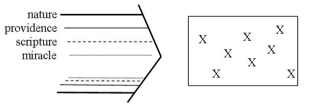
The broad-arrow model of guidance means also that the arrow may narrow or widen relative to people’s life as they move along depending on the relative preciseness of God’s will for them at each point along the way.
F. Prescriptive and permissive will
1. “If the Lord will”: Acts 18:21; 1 Corinthians 4:19; 16:7; James 4:13-15
2. The difference lies in where the idea comes from.
3. Why it is still his will: what God allows he has made decision on as surely
as what he initiates.
G. Data vs. signs: data are information we consider among other things in making decisions. Signs are indications of what God wants us to do. Unless something can be distinguished as a sign, we should treat it as a piece of information.
III. PRINCIPLES INVOLVED IN DIVINE GUIDANCE
A. God’s general will for all people is the beginning of his specific will for me.
1. We do not need a call to do what we have already had a command to do.
2. What he has already commanded everyone does not require special
revelation to each one.
3. When we make choices in terms of God’s values, he is leading our lives.
4. There may be more, but it is within what has already been revealed. The point is not to deny supernatural leading at any time, but to caution against considering certain experiences as special divine guidance when they are not.
5. We may not need more than general principles; so we do not demand it.
B. To the extent that God’s will is specific his leading must be explicit.
C. We are held responsible for what we can know.
What is capable of an alternate explanation is not capable of communicating God’s specific guidance.
In case either option is good, we will not be making a mistake.
D. God may specifically lead us without our knowing it.
We do not need to know that God is specifically leading us.
To deny knowing that he is specifically leading does not equal denying God may have a specific will for us.
E. God is often more glorified by the less he has to do for us.
As a father with a child, God lets us do as much as we can without helping us.
Even as God has given revelation in scripture, he has established natural and interpersonal processes.
Operating with us interpersonally means that we are not used as things or
eclipsed as zeroes.
F. If there is no special word from God, we are free to use our own sanctified
judgment.
SUMMARY: DEGREES OF GUIDANCE
1. God leads by revealed principle or demonstrated example.
As in the statement, this is a guiding principle. God’s leading is often like this; God is not positively doing anything; we are looking at his example or following his principles. When we follow his principles, we are following him.
2. God leads by invisible intervention.
3. God may lead by visible intervention: a vision, an audible voice.
christir.org