
Christian Marriage
CHRISTIAN MARRIAGE
Virgil Warren, PhD
INTRODUCTION
We are concerned about the way marriage should operate
so that one spouse is not overburdened and the other not “carrying his own weight,”
so there can be efficiency and orderliness,
so everything gets covered properly, especially the raising of children;
so that sexual needs are taken care of in a wholesome context.
Basic facts about marriage
Marriage is . . .
1. Between one man and one woman
a. God created one man and one woman in the beginning, not one man and several women or vice versa and not multiple members of the same sex (Genesis 2). For the hardness of heart certain anomalies were allowed in the Mosaic economy, but “from the beginning that was not so.”
b. Let each man have his own wife and each wife her own husband (1 Corinthians
7:2).
c. Sadducees’ question: “which one in the resurrection” (Matthew 22:23-30)
There is no New Testament concept of polygamy, polyandry, or homosexual
“marriage.”
2. For life
No divorce in principle; marriage was intended to be a permanent arrangement of mutual identification (Matthew 5:31-33).
3. Part of this life only
Matthew 22:30: “In the resurrection they neither marry nor are given in marriage, but are like angels in heaven”; cp. 1 Corinthians 7:31).
4. Beneficial but not required
Genesis 2:18: “It is not good that man should be alone; I will make him a helper
appropriate to him.”
1 Corinthians 7:28ff.; 7:7: “the fashion of this world is passing away.”
Marriage does not glorify, and the single life does not degrade.
5. A relationship requiring sexual fidelity
1 Corinthians 7:2: “Because of sexual immorality, let each man . . .”
MARRIAGE IS A TOTAL, PERMANENT, AND EXCLUSIVE RELATIONSHIP.
I. INTERPERSONAL CHARACTER
Marriage and the home are a specialized setting for personal relationships.
a. Anything else (sexuality and order) occurs within this qualifying context.
b. Marriage is a model of all other social relations and is the primary place where they are learned.
What we have learned about the products of love applied here first.
expression
development
The ultimate concept in marriage is oneness: Genesis 2:23-24
Genesis 1:27: Every New Testament principle about husband-wife relations is based on the creation account: sexual immorality (1 Corinthians 6:13b-20)
divorce (Matthew 19:3-6)
love (Ephesians 5:22-33)
The image of God involves the plural: us, our image.
A. Husband and wife are complementary.
unity amidst diversity
1 Peter 3: the woman is weaker vessel—STRENGTH (more vulnerable
vs. physically)
TENDERNESS
Neither of these qualities is absolute in
either or extremely different in either.
statistical by degree
B. Husband and wife are interdependent.
Equality involves twoness. Twoness is subsumed under oneness, as in the case
of trinity.
ONE FLESH: 1 Corinthians 7:3-5
equal in worth: Galatians 3:28: no male/female in Christ
1 Peter 3:7: joint heirs of the grace of life
Paul pictures interdependence by combining historical and natural facts (1 Corinthians 11:11-12): woman was created from man (animals not so), and man is born by woman.
As much as possible is taken care of within the principles of interpersonal give-and-take as guided by love.
II. STRUCTURAL OVERLAY
A. What is the structure? Ephesians 5:22-25, 28-31, 33
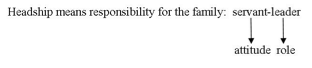
The husband is for the wife like Christ is for the church.

Authority is only given to fulfill responsibility.
Responsibility is only given if there is a job to be done.
A wife’s deference means simply that she acknowledges that God is holding her husband responsible for the success of the marriage and the family and that she acts accordingly. In the final analysis, deference is for the sake of good order.
B. What does responsibility mean?
Having responsibility is the only reason for having authority. In all cases where responsibility is involved, those who do not have final responsibility have a right to say, “I do not have to have my way, but I do want to have my say.” A respectful leader does not make choices without consulting those affected by the choices. In leadership of any kind, there can be some parceling up of areas of responsibility by mutual consent. A wife and husband can exercise complete control over certain parts of the whole operation of the home. Such an arrangement does not infringe on the husband’s final responsibility for that operation of the home.
The husband’s responsibility . . .
1. Reinforces the many elements in the interpersonal.
Not only does a husband want to fulfill his wife’s needs; God holds him responsible for doing so.
Ephesians 5: protect, nourish, cherish, love
2. Means someone is above to be responsible to.
The husband is not an ultimate authority.
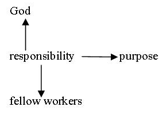
3. Is for good order in getting a job done.
Order is not to do it all.
not to make all the decisions.
not for refusing input.
not for being unapproachable.
not for requiring unquestioned obedience from the wife.
not for being better than she is in worth or ability.
Husband and wife are equal personally.
Husband and wife are unequal in responsibility levels
The complexity of married life is greater than the complexity level of single life, but the setup of the home is calculated to hold for the highest complexity level—family life: husband, wife, multiple children, extended family.
A problem sometimes posed: “There is no reason to put one person over another unless he is better.”
a. Good order is a reason beyond equal ability. Equal ability does not require equal station. “Everybody’s business is nobody’s business.” Besides, in unusual cases, when there is disagreement on something important, someone has to finalize the course of action.
b. Being better at being head does not equal being better period.
As with other kinds of social relations, putting family operations primarily in terms of authority becomes counterproductive.
Authority must be kept in low profile—as at best a back-up mechanism.
The psychology of authority creates a sense of distance.
The psychology of interpersonal relationship creates a sense of nearness.
There is the same relationship between husband and wife as between individuals in any organized setting: business, church, school, home.
Interpersonal relationship needs to overshadow all other considerations if for no other reason than to make the structure work right.
C. Why is the husband specified as responsible?
1. A practical reason
So there will not be a contest to see who will fulfill that role. It helps avoid
Competition to establish responsibility levels.
It is best that someone (besides one of the spouses) outside the set
specify who is responsible.
It can be embarrassing to have to vie with someone you love for leadership in a situation, not just between the two of you, but in the home as a whole with the children or in public. You feel selfish and self-centered when you do not want to feel that way.
2. A historical reason
Order of creation: 1 Corinthians 11:8-12a; 1 Timothy 2:14
Order of the fall: 1 Timothy 2:14
3. A natural reason—to optimize relative gifting
As a rule, a man may be more suited to that role than a woman is.
The biblical model may have been established in part to play to the typical strengths of both men and women—to optimize relative gifting.
a. Physically stronger vs. childbearing ability and attendant abilities that go
with it.
b. Physically stronger tends toward a psychology about life.
It is emotionally draining enough to raise children, without then having the responsibility of the home and earning a living on top of that.
Women may be more cautious because of their weaker physical constitution and their propensity to be protective of their children.
Deference may be easier for a woman than a man since women tend to be more narrowly focused than men.
Men tend to get their sense of identity from work (goal orientation) while women tend to get their sense of identity from relationships. This tendency may have implications for leadership emphasis and nurturing emphasis.
c. Personality correlates with sexual pattern (restraint and response), which epitomizes marriage.
The psychology of that distinctive in married life is crucial enough that it can permeate the operation of the home, hence, the church.
These “natural” differences are statistical by degree. Both men and women share virtually all personal qualities even though “on average” men are stronger than women, women are more affectively oriented than men, and some other notables as well.
Love and respect constitute a successful marriage and home.
New Testament teaching about men-women relations always assumes the standard situation: married with children. That may impact men-women relations outside that setting as with the unmarried (Philip’s four daughters that prophesied), those beyond child rearing years (Aquila and Priscilla?), widows (as with Lydia in Acts 16:13-15 and deaconesses? as in 1 Timothy 5). Over-reading New Testament comments even on a married woman’s role should be offset by the range of her activities praised in Proverbs 31.
christir.org