
Christian Unity
CHRISTIAN UNITY
Virgil Warren, PhD
I. THE IMPORTANCE OF CHRISTIAN UNITY
A. Apologetic purposes
1. Strength—Luke 11:18: “If Satan is divided against himself, how will his
kingdom stand?”
2. Credibility—John 17:21, 23: “I pray that they all may be one even as you, Father, are in me and I in you—that they may also be in us, that the world may believe that you sent me . . . I in them and you in me, that the world may know that you sent me and love them.”
3. Communication
B. Efficiency in Christian service
C. Richness of the Christian experience
D. The Christian purpose is to form a new united mankind: Ephesians 2:14-16.
“He is our peace, who made both one and broke down the middle wall of separation, having abolished in his flesh the enmity—the law of commandments contained in ordinances—that he might create in himself from the two a new united mankind, so making peace, and might reconcile them both in one body to God through the cross, having slain the enmity thereby.”
II. MARKS OF A DIVIDED CHRISTENDOM
A. Peculiar doctrines
1 Corinthians 1:10; 15:11: “I beg of you, brothers, by the name of our Lord Jesus Christ, that you say the same things and that there be no divisions among you.”
B. Exclusivistic attitudes
1 Corinthians 4:7: “Who makes you to differ? What do you have that you did
not receive? If you received it, why do you glory as if you did not receive it?”
C. Distinguishing names
1 Corinthians 1:12: “Now this is what I mean—that each one of you is saying, ‘I
am of Paul, Apollos, or Cephas.’”
1 Corinthians 3:23: “You are Christ’s, and Christ is God’s.”
D. Restricted fellowship
E. Separate organizations
III. APPROACHES TO CHRISTIAN UNITY
Three emphases by different groups and persons
A. Reformation takes the present as the frame of reference and changes only what is
necessary.
B. Restoration (primitivism) takes the beginning as the frame of reference and attempts to change only those matters that were considered negotiable from the beginning as represented in scripture.
C. Reductionism considers individual matters as having different degrees of necessity, some being negotiable and some not being changeable.
D. Cooperation allows Christians of varying persuasions to operate independently in day-to-day functioning while at the same time acknowledging each other as brothers.
IV. ASPECTS OF CHRISTIAN UNITY
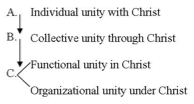
V. IMPORTANT DISTINCTIONS

What distinguishes Christians from the world is what unites them together.
A. Not all distinctives are equally important.
B. Conditions for “membership” do not equal the qualifications for leadership.
C. Unbelief does not equal disbelief.
D. Uncertainty does not equal rejection.
VI. THE INTERPERSONAL CENTER
A. Lostness is broken interpersonal relationship—alienation;
salvation is reunited relationship—reconciliation.
B. Feeling free not to think in all-or-nothing terms.
C. Regarding other Christians, put a high priority on attitude
motive
caring
humility
commitment.
Other Christians do not practice differently because they:
do not care what the Bible says;
do not believe the Bible;
lack intelligence to see the obvious;
are too weak to do what they know they should.
D. Regarding issues
1. Distinguish between opinion (issues with insufficient evidence).
fact (sufficient evidence; insignificant issue).
faith (sufficient evidence; unnegotiable issue).
2. Doctrines without practical correlates are not as central as those involving
moral behavior.
3. Formal matters are not so central as interpersonal ones.
“I desire mercy more than sacrifice” (Hosea 6:6; Matthew 12:7).
“The Sabbath was made for people, not people for the Sabbath” (Mark 2:7).
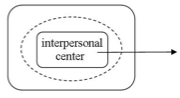
E. Importance of the interpersonal center
1. Prioritizes what naturally occupies the central place
2. Puts formal matters in proper perspective by interpersonalizing them
3. Creates the proper atmosphere for discussing formal and non-behavioral
doctrines
4. Establishes an appropriate frame of mind necessary for broadening the
common ground for unity in Christ
5. Recognizes that Christian unity must be a grassroots movement between
individual Christians
VII. AN INTEGRATION OF UNIFICATION PATTERNS
A. Individual Christians relating to others, not just as people but as Christian
brothers.
B. Interdenominational association to the extent of common ground in cities, regions, and world, while continuing to meet in congregational units where there is sufficient agreement to allow the group to operate. That procedure simply recognizes that we are not in sufficient agreement to work as a unit; presence with each other in general activities is not approval while at the same time separateness is only respect. Separateness and division are qualitatively different.
C. Organizational unification by moving to local autonomy with influence rather than authority operating above the congregational level.
CONCLUSION
What cannot be solved in fact we can solve in attitude, which can lead to a solution of other matters: distinguishing names, restrictive fellowship, separate organization, and even peculiar doctrine.
christir.org