
Dealing With Differences
DEALING WITH DIFFERENCES
Virgil Warren, PhD
INTRODUCTION
A. It is harder to relate to people who differ from us. We cannot do what is natural without offending and may being offended. People who differ from us are the very ones we may be drawn to, because we see in them the traits we wish we had.
B. The most far-reaching differences are religious beliefs and styles of living.
C. It is not possible to deal briefly with all differences in beliefs, but we can deal with ways to minimize difficulties that stem from different lifestyles.
D. Learning how to deal with people generally must precede dealing with differences in religious conviction.
I. MUTUAL RESPECT
Note some inadequate ways of trying to relate to those who are different from
yourself.

Two stick men standing in their dotted circles
can represent people who differ on a set of
ideas and values.

I undermine my self-respect when I yield
to unprincipled changes just to have
relationship. “I” become “you.”

I undermine trust in the other person if he
yields to unprincipled change just to have
a relationship. “You” become “me.”
 Mutual respect, or acceptance, allows every
person to remain who they are and go ahead
and relate to the extent of common ground.
The atmosphere established can help
contribute to mutual understanding, cleansing
of motives, and change that would not
occur otherwise.
Mutual respect requires two things: that we . . .
A. Distinguish person and values.
Person relates to the image of God that both people have (James 3:9).
B. Set aside feelings as a basis for association.
Mutual Respect/acceptance = Love
II. RANKING VALUES
Sometimes people have the same principles they advocate or activities they approve of, but they prioritize them differently. The difference becomes crucial when a choice has to be made on which way to do something; perhaps time will not allow for both.
Examples of this problem might be privacy vs. interaction
helping someone vs. doing your job
For people to relate best, they must bring their priorities into general conformity. Simply being aware that other people act the way they do because their order of importance differs from ours helps us understand why they have done what they did. We do not need to take their behavior personally, that is, as an indication that they dislike us.
III. BASIC VALUES
Basic values provide a sense of security.
The values we differ on are not particularly with moral considerations. The ones noted below tend to be amoral matters.
What is so destructive about these basic values is that we are not consciously aware of them. Consequently, we do not see other people as they see us. As long as these patterns continue to remain unconscious, we cannot put a finger on what causes friction between us.
For specifics on the following basic values, see the characteristics given for each on the accompanying pages at the end. At a more general level observe that . . .
(1) These values are not necessarily moral matters.
(2) They are not categorical differences but differences on a continuum. (People “tend” toward one end or the other.)
(3) People can change over time.
(4) We can recognize these tendencies when we have to choose
between them.
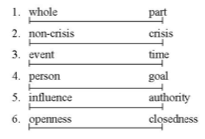
These are the kinds of things Paul may have had in mind when he said that he became all things to all men in order to win some (1 Corinthians 9:22).
A. Observations on individual pairs of contrasts
The greatest tensions exist between people who fall on opposite sides of the norm. Someone who stands in the middle is not as critical of someone to the right of middle as he is if he himself stands considerably to the left of center. There is even greater difficulty because the real question is not how accentuated the other person’s bent is, but how much distance there is between this pair of individuals.
1. The dichotomizing person will tend to see the holistic person as imprecise; the holistic person will tend to see the dichotomizing person as superficial.
2. The crisis person will tend to see the non-crisis person as wishy-washy; the non-crisis person will tend to see the crisis person as uncritical.
3. The event person will tend to see the time-scheduled person as impersonal; the time-scheduled person will tend to see the event person as disorganized.
4. The person-oriented person will tend to see the goal-oriented person as impersonal; the goal-oriented person will tend to see the person-oriented person as uncaring.
5. The authority person will tend to see the influence person as disrespectful; the influence person will tend to see the authority person as a bigot.
6. The closed person will tend to see the open person as reckless; the open person will tend to see the closed person as petty.
B. Observations on the full set of variables
A profile can be created by charting the way a person is in all the basic values to make a grid for comparison with us. The grid points out the tension points between us.
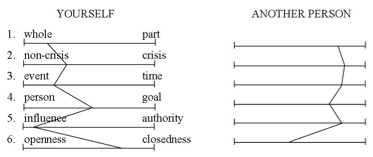
Proper attention paid to the difference in profiles can resolve many unnecessary tensions.
IV. PARTICULAR MECHANICS
A. Listen.
Make sure not to do all the talking, or you will not find out what is bothering
someone.
Learn to ask questions before making statements.
B. Listen smart. (Look past people’s words.)
1. Listen to criticisms and then look for the real problem. They may not be the
same thing.
2. Overlook “red” words. People do not always know how to express their negative feelings in emotionally neutral words. For example, “You are lazy” may be the words someone uses to mean no more than “You don’t work as hard as you could.”
3. Count on matters being overstated.
4. Anticipate people sounding mad when they talk about sensitive matters. Some people have to get almost mad before they can get said what they are thinking. Do not mistake embarrassment for anger.
C. Use the personal approach.
Using the telephone, sending an email, or writing a letter loses facial expressions, gestures, and voice inflection, which contribute to our meaning.
There is also the loss of ready reaction, which can allow matters to stew a while and further strain relations.
It may help, however, to use a trusted intermediary, which allows people to “save face” and not feel under pressure.
D. Describe rather than evaluate.
E. Let humility reign. christir.org