
Exercising Leadership in the Church
EXERCISING LEADERSHIP IN THE CHURCH
Virgil Warren, PhD
INTRODUCTION
A. A study on exercising leadership applies to everybody.
1. We all shed influence on people in our family, circle of friends, our neighborhood, at work. We do not have to be high up the ladder of leadership to be leading.
2. We are all to shed influence. The Christian calling involves calling others. Christianity is a call to leadership. Christian virtue sheds influence. When we act, we not only act but teach and lead as well.
3. We need to watch who we let lead us as much as we need to watch how we
lead.
B. The manner of exercising leadership must be compatible with the manner of obtaining it.
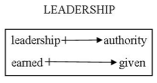
During the exercise of authority there is continuation, refinement, and perfecting those qualities and skills necessary for gaining and retaining leadership.
I. INFLUENCE
Influence is the total impression we make on people by way of our accumulated past and present impression.
We deal here with matters beyond the continued practice of what was involved in getting leadership, but those other matters must be kept in force.
A. Knowledge (Know what you are talking about: 2 Corinthians 11:6.)
1. Subject matter
Be a generalist; see the whole picture.
Do not be susceptible to pressure from special interest groups.
2. Situation
3. People
Analyze the people you are with.
4. Process of change
A leader is a change agent.
5. Planning
A leader needs to have goals, objectives, and purposefulness.
A leader needs to know how to get from is to ought.
B. Explanation (Leaders must be able to articulate: 1 Timothy 3:2.)
Note again “able to teach,” “able to reason through matters with people,”
“willing to be up front.”
Be willing to communicate. People cannot know what or why you think unless
you tell them.
Explain why rather than just telling what to do. Becoming authoritarian is a
common substitute for giving explanation.
Through communication bring other people along with you.
C. Example (Leaders must embody the ideals of the group.)
1. Personal life: Titus 1:6-7; 1 Timothy 3:2
Personal behavior must demonstrate integrity.
Make sure not to neglect your home life because of the press of leadership
duties.
Reputation draws people with an attentive ear.
Good self-image makes a person not get offended easily.
2. Skills
a. In decision making
Avoid making “snap judgments.”
Make proper use of input. This involves not being overly swayed by other people’s opinions while at the same time being sensitive to their ideas, needs, and preferences.
b. In delegating
Follow Jethro’s advice to Moses (Exodus 18:14-27).
3. Service
a. Doing for other people draws them to you and your goals.
b. Concern expressed for those under your charge fosters respect.
People are more important than programs: 2 Corinthians 11:28-29.
c. Keeping priorities enhances concentration.
God’s servant should not get entangled in the affairs of the world that
distract, dilute, detract from service (2 Timothy 2:4).
d. Suffering (2 Corinthians 11:23-27)
There needs to be a willingness to be alone and to forego personal
welfare and privilege. “It’s lonely at the top.”
Influence operates by persuasion and attraction: “We persuade people” (2 Corinthians 5:11).
Influence gives reasons, sets example, loves, gives positive reinforcement. It contrasts with trying to manipulate (aside from the will) or force (contrary to the will); hence, it contrasts with anger control, silence control, guilt control, bossiness, being “distant,” appealing only to authority.
Influence has to be high profile because the church is in the interpersonal business. It is not manufacturing a material commodity; it is advocating a way of living.
As much as possible should be done through influence. However, beyond influence, authority adds to leadership effectiveness.
II. AUTHORITY
Authority is the right to act as distinguished from the ability to act.
A. Facilitates influence
Authority enhances and builds an interpersonal relationship and the influence that flows from it. It does not replace the interpersonal, eliminate it, or work against it.
1. Reinforces influence

a. Authority recognizes influence.
A leader is not only viewed as having the ability to lead, but as having
the right to lead.
The “servant-leader” concept combines mentality and role.
b. Authority is based on influence.
Leadership must be retained the same way it was earned.
During the leading process, influence is what makes authority respected.
You cannot appeal to force (force, army, economics).
The church is a voluntary society; so it does not accomplish its purposes
in an authoritarian manner.
Authoritarianism characterizes the feel of worldliness.
Authoritarianism will not work, because people can leave the group, and
a church has no recourse; it is a voluntary society.
Authority should be exercised from as near at hand as possible, where its
reinforcement by influence can be felt.
2. Supplements influence

a. Order (authority equals authority flow equals organizational structure)
(1) Eliminates competition for ascendancy.
(2) Reduces confusion over who does what.
Helps make sure matters are taken care of. (“Everybody’s business
is nobody’s business.”)
(3) Provides a communication center, a nexus.
Consider yourself a coordinator of equals and often of
superiors.
Consider each better than yourself.
(4) Establishes a center for decision.
delegation.
direction.
b. Efficiency
Organization harnesses power, including influence.
Remember the efficient-effective distinction. Sometimes it is better to use a less efficient method because it is more effective in motivating people. Maybe that is simply because they are accustomed to doing it that way.
c. Discipline
Authority is invoked only when influence has been disregarded.
Practical advice: Appeal to authority only when influence does not apply or is insufficient. Keep authority at a minimum and in low profile.
B. Derives from responsibility
There are no figurehead positions.
Authority does not apply beyond the responsibility areas.

In the church responsibility (authority) is . . .
1. To someone above
hence, it is not self-aggrandizing, or for getting personal attention.
hence, it is not ultimate authority, but a delegated responsibility.
People in the group respond in light of the awareness that God is holding a
leader responsible and has given the leader the responsibility.
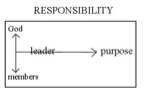
2. To the purposes and values of the group
hence, it is not for personal gain (1 Corinthians 12:28)
identify needs establish goals/objectives
determine schedules provide resources
give attention to following through establish priorities
assign tasks take initiative
3. For the members of the group
The leader is for the led, not the reverse.
Hebrews 13:17 (“give account”); cp. father for children
husband for wife
Christ for the church
Authority goes beyond personal responsibility to directing the activities of
other people.
People in the group respond in light of the awareness that the leader is acting out of concern for their welfare, even if they might prefer an alternative approach.
It is not so much a matter of controlling, which implies making people do what they do not want to do, as it is persuading them, which involves helping them want to.
You are first (authority) among equals (worth).
Persuasion is the way of fulfilling responsibility to God, for others, relative
to the purpose of all of us (2 Corinthians 5:11).
In the church, authority is never absolute because it is limited . . .
by the One who gives it,
by the purposes and values of the group,
by the welfare of those being led (Matthew 28:18b-19a).
CONCLUSION
Leadership is what good leaders do when they lead well.
Keep influence and authority in proper balance.
Use influence instead of authority whenever possible.
If influence is not setting the atmosphere, authority will not accomplish the task.
Within authority the stress falls on responsibility, because authority derives from
responsibility.
Servant leader = mentality + role
attitude + function
The manner of exercising leadership must be compatible with
(a) the manner of obtaining it.
(b) the products of the system in which it appears.
Leadership is not accomplished by “pushing buttons,” manipulating, pressuring, appealing to authority, or using force. It is accomplished by taking initiative, knowing what you are talking about, knowing what you are doing, and doing it “with zeal” (Ecclesiastes 9:10).
christir.org