
Growth Processes
GROWTH PROCESSES
Virgil Warren, PhD
INTRODUCTION
A. Description of the general Basic Christianity material
1. As a whole, Basic Christianity is Christianity in its in-life operation.
a. Vertical relationship to God
b. Horizontal relationship to other people
c. Personal development in the context of the two other dimensions
2. Part three deals with personal development under the conviction that personal development takes place in the context of vertical and horizontal relationships; that is, personal development is interpersonal.
B. The concept of interpersonalism
1. Influence vs. force, authority, or form
Influence creates tendency toward correlation between “cause” and “effect”;
force deals with a one-to-one pattern between cause and effect.
Since it is by tendency, influence operates by degree over time.
2. Reciprocation vs. one-way causal series
A major problem in Christian theology is the tendency to regard change as a one-way causal action—depravity, regeneration, entire sanctification, miracle, and so on.
C. Personal development
Since interpersonalism takes place by influence
between persons
by degrees
over time
through reciprocation
in wholeness,
it is natural for personal development to take place in interpersonal relationship
vs. monastic isolationism.
The interpersonal context provides a wholeness for personal development to take place in. The conviction is that personal growth occurs by the back-and-forth interaction of all parts of us, at one time, together with association with other people. Sin has affected the interaction of all parts of man and his associations; consequently, overcoming sin involves the interaction of all parts of us and our associations.
We would rather do anything than change (note developing love);
so we do not expect it to be easy.
well-balanced.
The goal of development is to make the person well-rounded.
well-adjusted.
I. THE NEED-ANSWER-USE FORMAT
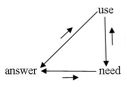
What leads us to Christ is involved in helping us grow in Christ.
In coming to Christ, we sense a need in our present experience. Apologetics then often begins in the present with that sense of need to be meaningful, innocent, loved, secure. It then moves to the answer proposed for the human predicament. In Christianity that answer lies in a cluster of events centered around the person, life, and work of Jesus Christ together with the meaning imbedded in those acts of history. Upon hearing the message and its promises, we begin to use what the Christian gospel calls for. Living out the message in our personal experience leads to further refinement of felt needs into real needs, which clarifies our understanding of the answer itself. And the cycle continues.
What is true about the way we come to faith and practice (apologetics) applies to continued growth in faith and practice. The format for apologetics incorporates the format for sanctification. As we conduct ourselves according to the Christian ethic, we continue to refine our understanding of the real needs in life. Furthermore, attempting to live in, say, a loving way helps us understand what the biblical answer means when it speaks of loving other people. That better understanding enhances better use of the answer to living. This whole process likewise strengthens conviction about the truthfulness of the Christian faith—apologetics.
More than one “pole” operates in coming to Christ and growing in him; one pole leads to another. In addition, that movement does not go in just one direction. It moves around the triangle in a reinforcing fashion, which is the mechanism that drives the process into a growth pattern. Reciprocation is the pattern for all growth processes.
We can deliberately take advantage of that system by keeping in mind that the process operates this way. Then we can analyze what the real priorities of our life are (need), immersing ourselves in the word (answer), and make certain that our present behavior corresponds with our present level of understanding (answer) and self-perception (need). Putting our energies into these three activities will yield the result indirectly. Growth does not come from concentrating on growing, but from concentrating on activities that produce the growth indirectly.
II. THE INNER-OUT FORMAT
A. Diagram #1
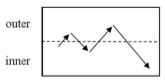
1. Components: inner and outer
a. Outer minus inner (O - I)
(1) Saying without meaning (Matthew 15:8)
(2) Habit without thought—hypocrisy (1 Corinthians 11:27-29)
(3) Ritual without content (Isaiah 1:11, 13)
Outer minus inner provides the appropriate setting for the saying, “You
cannot make up in doing what you lack in being.”
b. Inner minus outer (I - O)
(1) Knowing without doing (James 4:17)
(2) Believing without working (James 2:26)
2. Interaction of components
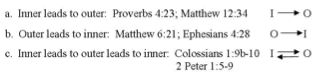
The inner level of commitment expresses itself outwardly.
The outer action deepens the intensity of the inner commitment,
which, in turn, produces greater outward expression, and so on.
B. Diagram #2
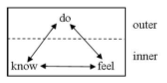
1. We have talked about the elements of the process: inner plus outer.
2. The pattern of the process involves growing interaction between inner and
outer.
3. We can now talk about where the process begins: either with the inner or
the outer.
4. We can also talk about how the process begins: by the external influence of
other persons.
The know-feel-do format brings into play the place of emotion, feelings, and motivation in propelling knowledge into action. Action on the outside becomes the most effective force in shaping affections, so the triangular pattern becomes self-propelling.
III. THE I-OTHERS FORMAT
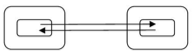
A. People
All personal associations can be helpful in one way or another; but to grow, we must put ourselves in association with people who noticeably . . .
1. Love and care about us.
2. Share our values, purposes, and commitments.
We must also
3. Do for them as well as receive from them.
We people are expressive as well as responsive beings. We must have
output as well as intake.
B. Holy Spirit
The Spirit’s role is to guide
empower
intercede for, and
unify God’s people.
Whatever we can do to increase our conscious awareness of the Holy Spirit’s real presence with us empowers us to boldness, evangelism, and self-improvement.
We are speaking here of the natural operation of the Spirit for all people everywhere rather than the supernatural role of the Spirit for some people in special circumstances.
IV. THE STRENGTH-FOR-WEAKNESS FORMAT
Emphasize strengths as orientation points and let them drain off to other aspects. This phenomenon occurs because of the wholeness of the individual person. Overcome weaknesses by emphasizing strengths.
Playing to our strengths tends to dissolve our weakness behavior Using our strengths raises our self-image, and much weakness behavior results from poor self-image. We do competitive behaviors to say to ourselves that we are strong, because we are not very sure we are.
CONCLUSION
Weightlifting illustrates the growth process. Working out with 100 lbs. does not enable us to lift just 100 lbs. Using that weight for a while strengthens us to lift considerably more than 100 lbs. That is how it is with continued practice of Christian virtue: it enables us to do more than the amount we are already managing. We find ourselves growing because we continue carrying out those activities natural to the Christian walk.
Taking on something a little bigger than we can do now stretches us. Sometimes we have to tackle a job that is too big for us so we can grow into it.
The value of adversity lies in forcing us out of the lull of life, routine living, and comfortable righteousness and making us take a more intense pattern of Christian living just to endure the negative experience. Paul says in Romans 8:37, “In adversities we are more than conquerors through him that loved us.” We are more than conquerors because these experiences bring growth.
christir.org