
Influencing for Christ
INFLUENCING FOR CHRIST
Virgil Warren, PhD
INTRODUCTION
A. Deliberate choice of term: influencing
1. Avoids professionalizing the ministry as something done by specialists: it is
all to be involved in as they are able.
2. Avoids hollow ministry by ministers with low life quality
3. Done by persons
to persons
in interpersonal ways
B. The interpersonal nature of the Great Commission: Matthew 28:19-20
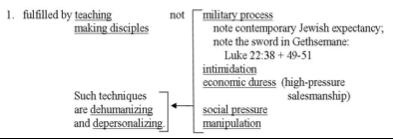
2. The way the kingdom is spread must be in keeping with the kind of
kingdom it is.
3. The way the kingdom is spread must be in keeping with the purpose of the
kingdom.
The kingdom is not of this world; therefore, it is not furthered by worldly
means and methods.
The kingdom is heavenly, transcendent, spiritual, interpersonal.
C. Paul’s example
1. “We persuade men” (2 Corinthians 5:11).
2. “He reasoned in the synagogue” (Acts 18:4).
3. “I determined to know nothing among you except Jesus Christ and him
crucified” (1 Corinthians 2:2).
a. There is no pride in serving someone who was crucified; it is humbling
yourself to death.
b. Knowing nothing plus tentmaking (Acts 18:3) equals not getting caught
up in worldly things that are ends in themselves
Retains the integrity of others and requires integrity in us.
(teaching) (a way of life)
4. He summaries his work as a “ministry of reconciliation” (2 Corinthians 5:18-19; Colossians 1:20-22; Ephesians 2:16)
I. REMOVE DETRACTORS. (Presence)
A. Problem
Romans 2:24: “The name of God is blasphemed among the Gentiles because of
you.”
2 Peter 2:2: “Many will follow their sensual ways on account of whom the way
of truth will be evil spoken of.”
We wonder what Christianity could do if Christians would stay out of the way.
We “hinder the truth in unrighteousness” (Romans 1:18).
B. Mission-ministry is not a profession.
Mission is advocating a way of life.
It is a quality of life we are calling people to and a relationship to God as a way
of life.
That is the primary distinctive of it and impetus for it.
Faults in the personal life of a doctor, lawyer, grocery store manager do not necessarily mean he is not a good doctor, and so on, but here we must possess what we are trying to get others to accept.
Ungodly peddlers of God are like dentists with bad teeth.
sick doctors.
poor money investors.
C. Areas of importance
1. moral matters
a. honesty in business matters
b. dependability
c. proper attitude (no combativeness, anger, disrespect)
d. good family life
2. opinion matters
a. proper use of freedom and rights
b. proper use of expediency and love
3. responding to evil with good
It affects all our actions significantly when we think first about their impact on
other people, including kids and prospects. It helps forgo and forgive.
D. Goal
Titus 2:8: “In all things show yourself an example of good works . . . so that
those who are of the contrary part may be ashamed having nothing evil to say of you.”
1 Timothy 4:12: Be an example so no one can despise you.
1. Not a negative influence in the world (Matthew 5:21-37)
2. Not hitting back (Matthew 5:38-40)
3. Building relationships (Matthew 5:41-48)
Do not be satisfied, though, with not making things worse.
II. DO POSITIVE GOOD. (Presence)
A. Go out of your way (grace).
1. Initiate good; do not just react to other people’s good.
a. Be there in times of change (availability).
Note transition times: loss of job
loss of loved one
getting married
kids leaving home
financial setback
divorce
In times of change, people have to reorganize and reintegrate their lives,
which brings in again the big questions about life.
b. Be there in times of need.
2. Return good for evil.
Do more than others (Matthew 5:40-42, 46-47).
Go the second mile.
Bless for cursing (Romans 12:21)
Our impulse is to avoid those who have wronged us. Instead, we are called to
do good to them just as to anybody else.
B. Let people help you.
Jesus built a bridge of relationship with the woman of Sychar by asking for a drink of water. We can do that with non-Christians.
C. Goal
1. That people will glorify God because of us: Acts 2:46-47; 5:13-14a
2. That we will win people by our godly lives: 1 Peter 3:1-2
3. That we do the kind of good that calls for an explanation
4. That we do the kind of good that brings people to us when they do have
a need
Up to this point we have been talking about lifestyle evangelism.
demonstration evangelism.
presence evangelism.
Lifestyle evangelism serves to win the right to tell people about the ultimate questions of life. Presence evangelism gains us credibility. Demonstration evangelism can be the functional equivalent of Jesus’ miraculous healing ministry.
The limitations in lifestyle evangelism
a. It does not tell people why we live the way we do. They cannot see the reason for our living that way. They must understand our reason, or we are just another good person. We need to give the cup of water in Jesus’ name.
b. It does not tell people why they need Christ.
III. EXPLAIN WHY. (Persuasion)
A. Testify about what Christ means to us. (People cannot argue with that.)
has done for us. (cp. Gadarene demoniac)
B. Describe what Christianity is.
1. Know the message, the scripture, and people’s present ideas.
2. Use the concept of inherent apologetic: correlation with life.
consistency within itself.
3. Remember God’s responsibility for the power of the truth itself.
C. Be ready to give an answer for the hope that is in us.
Others often initiate; situations often initiate. Opportunities often come to us
from beyond us.
Redeeming the times often means waiting till opportunities come. Much in influencing for Christ is beyond our control. We often must wait for circumstances to create readiness for the “education” we call evangelism.
D. Be prepared to show the weakness of other positions about life.
IV. MAKE SPECIAL EFFORTS. (Proclamation)
A. Saturation evangelism
B. The apostles had to proclaim to the very ones they feared.
C. We can create opportunities to speak: Jesus and the woman of Sychar.
One thing to watch here is getting “hokey,” artificial.
D. Pay particular attention to those we can influence:
1. family members
2. work associates
3. neighbors
CONCLUSION
Influencing for Christ becomes a way of life. Go about life with “church-growth eyes.”
A. It simplifies things when we can make them into parts of one whole thing.
B. Under the influence model evangelism motivates our own Christian living. Christian living authenticates evangelism.
C. The influence understanding of missions shows how all of us can be involved in the conversion of others: one plants, another waters, someone else harvests.
D. Influence turns us outward, the basic requirement for evangelism.
christir.org