
Love Spirals
LOVE SPIRALS
Virgil Warren, PhD
INTRODUCTION
A. Dimensions of personal life
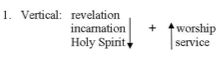
2. Horizontal: social relations, weaker brother relationships, church, home
3. Personal
Experiencing the horizontal helps us understand the vertical;
understanding the vertical motivates us to do the horizontal.
B. Concept of interpersonal relationship
1. Reciprocation (e.g., feedback between a guitar and amplifier)
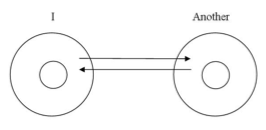
a. Degree The reciprocal process forms a spiral, not a circle; the process
comes around to the first person at a higher level than where
it began.
b. Time It takes time to change.
2. Influence (vs. force or determinism)
Biblical love means influence (not cause) plus reciprocation (not the domino
effect only).
C. Method of Bible study to get at this idea: topical study by using a concordance
on the word love.
I. GOD-TO-MAN LOVE SPIRAL
A. Pattern of the relationship
John 3:16: “God so loved the world that he gave his only Son.”
John 14:15: “If you love me, you will keep my commandments.”
John 15:10: “If you keep my commandments, you will abide in my love.”
1 John 4:19: “We love because he first loved us.”
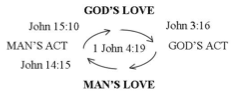
What is true of the love-give-love cycle is likewise true of the love-forgive-love cycle. Luke 7:47: (a) Who loves much is forgiven much; (b) “who is forgiven much loves much.” Note the two ways of reading James 5:19-20; 1 Peter 4:8; Proverbs 10:12; 1 Corinthians 13:4-7. “Love covers a multitude of sins.” Does it mean a loving person tends to overlook the sins of others? Does it mean people tend to overlook the sins of a loving person? Who is doing the loving—the forgiver or the forgiven?
B. Application
1. Love provided the context for redemption.
Love motivated the atonement: John 3:16.
2. Love establishes the character of our relationship to God.
a. Changes fear to love: “This is love—that we keep his commandments,
and his commandments are not grievous” (1 John 5:3).
b. Changes meanness to discipline: “As many as I love I reprove and
discipline” (Revelation 3:10; cp. Proverbs 3:3-5).
3. Love shows the justice of God’s condemnation.
Rebuffed love is condemned on all hands.
4. Love avoids the specter of a self-centered God.
The reason for the creation was “to the praise of (the glory of) his grace”: Ephesians 1:6, 12, 14. God gets his glory from the praise and gratitude of those to whom he has first given of himself.
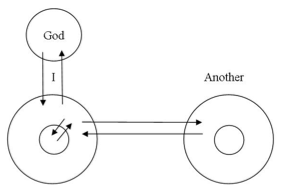
What avoids self-centeredness in God provides the model for avoiding self-centeredness in people. The vertical and the horizontal have the same features: interpersonal acts and processes. Vertical and horizontal relationships are never separate. In fact, many of God’s blessings to other people are channeled through us.
II. MAN-TO-MAN LOVE SPIRAL
A. Pattern of the relationship
Golden Rule: Matthew 7:12
First Great Commandment: Matthew 22:39-40
B. Application
1. Sets the pattern for expressing love (defines love):
responsible caring, intelligent good will, acceptance, mutual respect, self-
giving for the joy of others.
People may be afraid to love because they fear getting run over, being made a doormat, being made into a zero, being taken advantage of. They become assertive as in being aggressive.
a. Letting people take advantage of us is not being loving; it is not good for them. We stand up for ourselves because we love them, not because we are being assertive.
b. Part of the answer to this perceived problem is that love tends to beget love (instead of running over). In fact, unreturned love is the height of sin. (The Parable of the Unforgiving Servant.)
2. Demonstrates how to reverse the downward spiral of deteriorating
relationships.
Reversing the spiral is by an act of love in response to evil—turning the
other cheek.
God’s not returning in kind to us moves us to do the same thing to others.
Jesus chose healing miracles to win the right to be heard about the gospel.
A soft answer turns away wrath (Proverbs 15:1).
3. Provides the atmosphere for evangelism and ministry.
“The love of Christ constrains us” (2 Corinthians 5:14).
III. PERSONAL GROWTH SPIRAL
A. Pattern
Personal growth takes place in the give-and-take of vertical and horizontal personal interaction. Growth is a product of those reciprocating patterns.
B. Application
1 Corinthians 13:5: “Love is not easily provoked” (self-control).
1 John 4:18: “Love casts out fear” (security).
Most virtues are somehow connected to love in scripture.
CONCLUSION: THE PRIMACY OF LOVE
1. The amount of material about love in the Bible
2. The fact that it fulfills the Law: Matthew 22:34-40; Galatians 5:13-14;
Romans 13:8-10. Love helps us know what to do and moves us to do it.
3. How inclusive it is
total person: mind, will, action, feelings
total virtues: the number of virtues associated with love
All personal processes involve love, whether vertical, horizontal, or internal.
4. How longstanding it is: “love never fails” (1 Corinthians 13:8)
5. Its relative importance
More important than knowledge: “Knowledge puffs up; love builds up” (1
Corinthians 8:1).
More important than supernatural gifts (1 Corinthians 12:31). It is good to
desire gifts, but it is better to love people.
Greater than faith and hope: 1 Corinthians 13:13
6. How often we can call on it to solve problems
The use of supernatural gifts: 1 Corinthians 12-14
Relationship with weaker brothers: 1 Corinthians 8 (meat); Romans 14:15
7. What it is called
The Great Commandment: Matthew 22:34-40
The Royal Law: James 2:8
The Golden Rule: Matthew 7:12
The Law of Christ: Galatians 6:2
8. What it produces
Love causes us to overlook faults in others if we love them; love causes us to overlook faults in other people if they are loving people; so it is especially good when we loving persons overlook the faults of loving persons. Love for others can even cause us to overcome our own faults so we will not be harming them.
Luke 7:47 points out that the sinful woman’s sins were forgiven “because
she loved much.”
CONCLUSION
Basic Christianity is summed up in the one word love.
christir.org