
Meaningful Life
MEANINGFUL LIFE
Virgil Warren, PhD
INTRODUCTION
Can we give any reason for considering ourselves significant?
Do we feel significant?
How much of our time, energy, and resources is spent on the quest for meaning?
Importance of meaningfulness
Results of meaninglessness are boredom, pleasure seeking, escape (drugs, suicide,
etc.), hedonism, materialism, busyness, struggle for power.
John 10:10b: Jesus came that people might have “abundant life.”
Definition of meaningfulness
The term life does not mean “existence,” but “meaningful existence.” It has to do with quality, not quantity. It includes a state of perceived “blessedness.” Meaningfulness comes from being part of a guaranteed purpose that is bigger than us.
Basis of meaningfulness
Meaningfulness is based on persons acting together toward a common goal. Meaning does not come from individuals in competition with each other, but from belonging to the group (existential) and contributing toward its needs and purposes (eschatological). It is love, not competition. Only what is omnipotent can determine its own meaning.
Meaningfulness in mankind comes from nature (image of God), relationship (love of God and man), and purpose (to the praise of the glory of his grace; God’s delight).
I. COMPONENTS OF MEANINGFULNESS
|
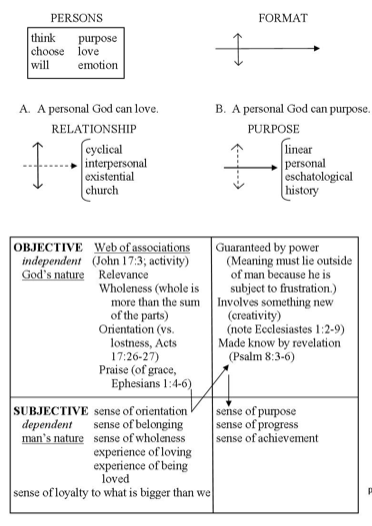
II. CAUSES OF MEANINGFULNESS
Meaninglessness comes from sin because sin breaks relationships and frustrates
purposes.
Ecclesiastes 12:13
Romans 8:20-21
III. ALTERNATIVE TO THE CHRISTIAN VIEW OF MEANINGFULNESS
A. Hedonism (entertainment): Ecclesiastes 6:7
B. Materialism
Ecclesiastes 5:10: “Those who love silver are not satisfied with silver.”
Luke 12:15b: “People’s life does not consist of the things they possess.”
The whole universe viewed from a human being’s viewpoint may be awesome, but it is still meaningless.
In an omniscient (vs. impersonal) reality, “blessedness” provides a major element in the meaningfulness picture. A human person is known and accepted by a principled omnipotent person. [personal content]
C. Escape (suicide, drugs, asceticism, sleep, busyness): Ecclesiastes 2:18-19
Striving after altered states of consciousness is not the goal of Christianity as
it is among Eastern religions.
D. Knowledge: Ecclesiastes 1:18
E. Being remembered: Ecclesiastes 2:15-16
F. Fame
G. Friends
H. Power
CONCLUSION
Death is the critique on material-based approaches to living.
christir.org