
Obtaining Christian Leadership
OBTAINING CHRISTIAN LEADERSHIP
Virgil Warren, PhD
INTRODUCTION
A. Leadership is not obtained by
1. Heredity (contrast kingship and priesthood in Judaism)
2. Force (note Peter in Gethsemane)
3. Purchase (note the Medieval practice of simony; cp. Acts 8:14-24)
4. Shortcutting
a. “Riding in on someone else’s shirttail”
b. Building on another’s foundation (2 Corinthians 10:13)
c. Attempting to enter at the top (Mark 10:35-45)
d. Attempting through formal education to bypass lesser roles in climbing
to the top
5. “Pushiness”
Competitive behavior creates the adverse effect.
“Clamoring for the chief seats”
6. Refusal to be involved otherwise (the “won’t-work-so-let-lead” syndrome)
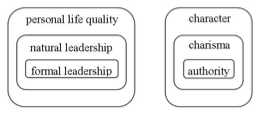
B. Charismatic leader vs. official leader
natural leader vs. formal leader
judgeships vs. hereditary kingships
THE OVERALL PATTERN FOR OBTAINING LEADERSHIP

Any group will have structure; the only question is how it comes about: by appointment before the group forms and outside the group, by emergence through competition within the group, or by a leader gathering a loyal group (leadership by seniority reinforced by force).
If there is no order, there will be disorder, inefficiency, and ineffectiveness in direct proportion to that disorder.
I. LEADERSHIP EARNED
A. Qualify ourselves.
Those who most exemplify the values honored by any group are the ones who lead it (Hebrews 13:7; Titus 1:6-9).
1. Moral qualities
All the Christian virtue lists end up being leadership qualification lists. Conversely, qualification lists end up being virtue lists; they are lists that summarize those qualities that make people great in a relevant way.
2. Social skills
Learn to enjoy being around people with their faults.
A leader cannot be a loner; religious hermits do not lead the church of
Christ.
We have to develop awareness of what makes people tick.
We need to learn to get along with people.
We must work at overcoming habits of speech, gesturing, and so on, that come across as socially awkward. Take the risk of asking other people that we respect what may be detracting from our social effectiveness.
Leadership roles are not given to negative people.
3. Wholesome practices
hospitality
benevolence
work (goal orientation)
4. Domestic qualifications
Light associations at church, work, and business do not always tell people what you are like; so they look at your family as a way of gauging what you must be like in the continuous, intense, and intimate aspects of home life.
Question the expediency of trying to serve in ministry if the spouse’s or children’s lives are not appropriate to that calling.
It is not possible to professionalize the ministry, because it has as its “business” the raising of life quality. “Physician, heal yourself” comes into the picture.
The viewpoint here differs from the attempt by some politicians to act as if their private lives do not impact their work. Similarly, those seeking leadership positions may try to separate themselves from the character of spouse or children. These attempts reflect a desire to remove the bases for evaluation that other people have to look at before they grant leadership responsibility.
B. Equip yourself.
1. Understanding (KNOW) (“education for use”)
a. Bible (exegesis)
b. Theology (topical treatment)
c. Typical challenges to Christian truth (Titus 1:9: “refute”)
d. Information involved in our field of interest and service
2. Skills (TELL)
a. Verbal skills (preach, teach, counsel, writing)
“Be articulate” (1 Timothy 3:2), which involves fluency and coherence.
Be able to make a through presentation (not just be a discussion leader who plays off of the comments of others).
Be able to reason through matters with people, not just state conclusions.
b. Social skills
Develop an outward-looking personality.
Strive for a healthy kind of extrovert personality through simple things like making eye contact, speaking up/projecting, demonstrating holy boldness, smiling.
Be able to get up in front of people, not just to engage in one-on-one
presentation.
Be able to counsel with people one-on-one, which calls for approach-
ableness.
3. Behavior traits (DO)
Get away from the entertainment mentality. Work is goal oriented; play is not. Be willing to work on your personality to modify it rather than treat it as a given, set, or unalterable thing. Get away from too low a level of expectancy.
a. Initiative: A leader has to be a self-starter.
b. Positive attitude: focus on the good (vs. weaknesses).
focus on possibilities (vs. hindrances).
c. Enthusiasm, A slow-moving, unemotional person is not able to
aggressiveness keep other people’s attention.
d. Tenacity (Philippians 1:12-14)
(1) Stability
(2) Carry through; be a finisher.
(3) Not quitting or giving in too easily when opposed or tested: “refute
critics” (Titus 1:9)
Start helping with the area of service; be around its people.
C. Be involved.
1. Leadership for the church comes from within the active membership.
Israel was to choose a king from among its own people.
Leaders are not hired in from the outside as they often are in the business
world.
2. Willingness to follow precedes opportunity to lead.
The values of this approach include the following observations:
a. Willingness to support implies that we will not abuse leadership when it is given because we are not self-centered, or do not have an overly high opinion of ourselves. It communicates concern for the purpose of the group first and foremost, regardless of our place in it.
b. Willingness to support implies that we will not consider leadership as just a job if it is given to us.
c. Willingness to support implies that you have a cooperative spirit and that you will not just run off heedlessly doing whatever you want if you become leader.
d. Willingness to support implies a basic willingness to work even if there is no prestige in it for you.
Do not wait until a situation is as it should be before we “lower ourselves” to associate with it. In the meantime, we will probably be criticizing and complaining about the present leadership.
Do not implicitly demand leadership as a condition for being involved.
3. Much learning must come by doing.
Learn by doing so we can lead those who are doing.
Leaders are leading in an activity, the art of living.
the art of doing church work.
We must win the confidence of doers by being able to do the job well
ourselves.
Much of what needs to be known must be learned in the situation itself:
internships, associate worker, two-by-two activity.
D. Be available.
Be at the right place at the right time: the person makes the situation, but the situation also makes the person.
Know the right people and keep yourself in contact with them.
Do not have your life so filled you cannot take the opportunities if they come.
Have your life flexible enough that you can accept opportunities of being called into leadership roles. Make your life as uncluttered as possible.
Be willing to let go of lesser things when bigger ones come along.
II. LEADERSHIP GIVEN
E. Be faithful.
“Be faithful in little to become responsible for much.”
The Parable of the Pounds (Luke 19:11-27)
The Parable of the Talents (Matthew 25:11-30)
1. The doctrine of calling (Be faithful in order to be called.)
The right to lead comes to us from beyond us. There can be various degrees of divine involvement even to the point of supernatural involvement.
Even Christ did not make himself a priest but was called like Aaron.
a. Not all who are qualified for a task are necessarily needed for that task.
b. Other people may be better qualified to evaluate us.
They are not biased by our personal aspirations.
They can see the total impression we make on them.
The hardest thing in the world to see is ourselves.
2. Lower to higher (Be faithful here to be called higher.)
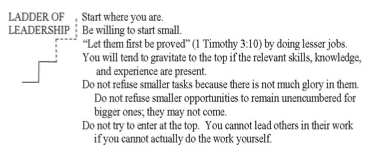
Starting lower and moving higher answers some problems:
a. How to get the experience required for a job that requires experience.
Minimize the lack of experience by doing related, lesser jobs. In the process, you will probably be around the higher job to see how it is done.
b. How to give leadership without risking the destruction of the body.
c. How to give people a significant job when we do not know whether
they can do it.
If there is failure at a lower level, the negative effects are not so great.
Becoming and choosing leaders best occurs by adopting procedures like these:
1. Give a lower, introductory job so that if there is a failure, the effects will not be wide-ranging.
2. Choose from those who are involved, because they show an interest in the task for its own sake, uncluttered by self-ambition.
Those around the tasks have also seen someone else do it.
3. Show yourself willing to follow as evidence that when you lead it will not
be self-seeking.
4. Make sure that the accompanying factors in your life are well in order:
personal life, children, spouse.
CONCLUSION
In dealing with the inordinate desire to be boss, remember that . . .
1. Leaders are more strictly evaluated (James 3:1).
2. Leaders must earn their respect.
3. Leading requires more than following, not less.
4. Once leaders fail, they have a harder time regaining leadership.
dimensions of development
upward Everyone, especially a leader,
outward needs to work at these to be
inward well rounded and fully matured.
christir.org