
Products of Love
PRODUCTS OF LOVE
Virgil Warren, PhD
INTRODUCTION
Bible Study Method: ask a question and read scripture with an eye for answers.
Application of this method to 1 Corinthians 13: “What does love produce?”
I. PRODUCTS OF LOVE
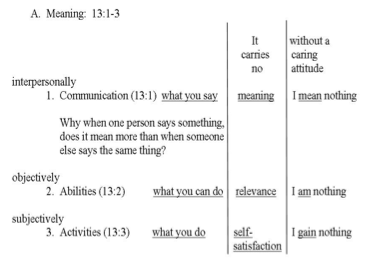
Acts that are not heartfelt do not yield a return because they do not pick up the appreciation of other people when they return to us.
They are perfunctory.
They demonstrate going through the motions.
It is not so much what we say, what we can do, or what we do, as it is the attitude we do it with.
Communication becomes meaningful through love and relates to an observation about persuasion in rhetoric: the ethos of the speaker enhances the impact of the speaker’s words on the audience.
B. Patience: “Love is patient and kind” (13:4).
Those you love the most you are the most patient with.
Most “familiar” does not mean most loving. We presume on relationships we are more comfortable with. We are more open and frank with people closest to us.
C. No envy: “Love is not jealous” (13:4).
Jealousy links up with pride, as if Paul was thinking of both sides of the interpersonal relationship. One person is not jealous of another’s good fortune and that other person is not proud of having what the first one could have been jealous of. Love is the answer for mis-action on both sides of any unequal relationship.
D. Humility: “Love does not vaunt itself up—is not puffed up” (13:4).
E. Appropriate behavior: “Love does not behave itself unseemly” (13:5).
Love does not ask just about what is right or wrong. Love is sensitive; it discovers an appropriate way to act with other people even if what is involved is merely preference among good things.
Love projects consciousness over behind the eyes of the other person.
Love is not unseemly, because unseemliness is a form of self-centeredness.
Not behaving in an unseemly way links naturally with not seeking its own, because the lack of the former stems from a failure to live interpersonally; it stems from self-centered living—from thoughtlessness if not from intentional mis-action toward the other person.
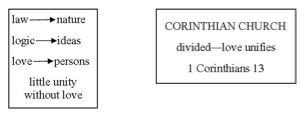
This element takes care of both law and wisdom. Wisdom and love can cross cultural barriers, societal differences, individual variables.
F. Selflessness: “Love does not seek its own” (13:5).
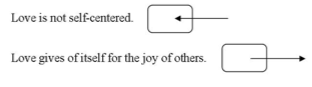
Love is willing to get its satisfaction indirectly through the response of others first loved by us. There is more there because the happiness of others is added to it as it returns to us.
G. Self-control: “Love is not easily provoked” (13:5).
Love does not get mad quick.
Anger is a fear reaction: “Perfect love casts out fear” (1 John 4:18).
Love brings boldness; hence, the fearful do not inherit heaven (Revelation
21:8).
H. “Forgivingness”: “Love does not keep track of evil” (13:5).
1 Peter 4:8: “Love covers a multitude of sins.”
Love overlooks faults in others.
Love overrides our own faults in other people’s eyes.
Love eradicates other people’s sins in response to our love.
Love tends to look for the best in people.
Love tends to overlook their faults, does not hold grudges; yet is not blind to
people’s faults.
Love is not critical; it does not glory in how many mistakes it can catch people
at.
I. Honesty: “Love does not rejoice in unrighteousness, but rejoices in the truth”
(13:6).
Love does not enjoy seeing someone done in.
Note the application to the problem of gossip.
Proverbs 24:17
Imagining what it is like to be in his condition now helps us not to rejoice in
the conditions that have come on him from his bad choices.
J. Strength: “Love bears all things” (13:7).
Love can take a lot.
Some people can handle more because they are made strong by caring.
K. Trust: “Love believes all things” (13:7).
“Love tends to trust” does not mean “love is gullible”!
Love is willing to take the risk that such trust will not be betrayed.
L. Positive outlook: “Love hopes all things” (13:7).
Love produces a positive outlook on life; it works against the doomsday mentality or a defeatist attitude.
Love anticipates the best from other people.
Love becomes a self-fulfilling prophecy for good because love tends to draw the best out of people.
Love not only takes a positive attitude toward other people; but because it does so, it also takes a positive attitude toward the future. Hope is possible because we trust loving people to assist us in obtaining good for tomorrow—especially do we view a loving God that way.
Perfect love casts out fear (1 John 4:18) of others (so that we have a natural boldness toward them) and of the future. Generally, fearful people do not feel acceptance; so they tend not to trust. Love gives a sense of security.
Love not only produces things in our loving behavior toward other people; it produces things in us through the loving behavior of other people toward us. When we speak about the products of love, we mean products in our behavior toward them and in us because of their behavior toward us—products both in behavior and as a result of behavior.
M. Steadfastness: “Love endures all things” (13:7).
Love does not run away; it remains under the load.
N. Endurance: “Love never fails” (13:8).
Greatest is love because love . . .
1. lasts the longest
2. is the source of faith and hope
3. is the most all-purpose human virtue
4. is indestructible
Love always stands us in good stead.
Love eliminates self-centeredness.
Many of the virtues loves brings because love eliminates competition.
Love provides the approach to personal relationships.
II. QUESTION: AM I A LOVING PERSON?
Many of these items can be turned around to discover the answer to that question.
Some things do not mix with love. They are like oil and water.
flour and warm water.
creamer and cold water.
Some things do not mix with love/caring: impatience
jealousy
pride
insensitivity
self-centeredness
temper problems
criticism
grudge bearing
rejoicing over the fall of an opponent
not being able to handle much
distrust
being a negative person
There is not much point in trying to claim the virtue of love if these faults plague
us.
CONCLUSION
christir.org