
Questions About Prayer
QUESTIONS ABOUT PRAYER
Virgil Warren, PhD
INTRODUCTION
Prayer Is talking to God.
Prayer is like talking to other people; we just have a special word for talking to
God.
Several things we can do in TALKING to God (prayer): express how we feel, thank, praise, rehearse matters with him, make promises, confess sin, ask for ourselves and for other people.
When it comes to prayer requests, some questions come up.
I. If we receive whatever we ask in Christ’s name believing, why are not all our
prayers answered “yes”?
A. Setting up the problem: Matthew 7:7 (= Luke 11:9); 18:19; 21:21-22; 17:19-20; Mark 11:24; John 14:13; (15:7); 15:16b; 16:23-24; 1 John 3:22; 5:14
Some have taken a “name-it-claim-it” attitude toward prayer; and if it does not happen, there is something wrong with the faith of the one who prays.
Two things against the name-it-claim-it attitude:
1. Our experience shows otherwise. We can always be put on a guilt trip by claiming we did not have enough faith.
2. Scripture shows failures to receive requests.
a. Jesus’ prayer in Gethsemane
b. Jesus’ prayer for unity
c. Paul’s prayer for his thorn to be removed
d. James, the brother of John, was not delivered from the sword (Acts12:2); John probably prayed as much for his release as he did for Peter’s.
B. Solutions
1. Other interpretations
all kinds (not just spiritual things, not just things that are likely going to
happen anyway)
what vs. opposite—Asking for one thing vs. another thing when the main point is not receiving the undesired thing; that leaves the positive answer to come in other ways than the petitioner specifies.
my name (yet Matthew 21:22, e.g., does not say my)
These three could still allow for receiving everything; so the following matters come into the picture.
2. Are you sure it is, in fact, not answered?
answer our response
YES THANK
NO ACCEPT
LATER WAIT
IF HELP
INSTEAD RECOGNIZE BETTER
3. Proposed
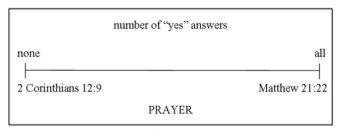
All prayers are answered “yes” except for:
a. Cases where there is some lack in us
We may have to do our part to help produce the answer.
Our motives may not be right: James 4:3.
We may not be obeying his commandments: 1 John 3:22.
We may not be treating other people right: 1 Peter 3:7.
We may lack earnestness and sincerity: Luke 18:8, 20:46-47.
We may lack faith: James 1:6-7; Matthew 21:22.
We may not be forgiving other people: Matthew 6:15.
But if these were the only explanations, the “failures” of prayer would mean guilt each time we did not receive what we requested; so we offer the following observations as well.
b. Cases where the request runs counter to God’s other principles of
operation (John 14:13-14; 15:7; 1 John 5:14)
(1) What involves other people’s free will to reject
(2) Once to die and then the judgment (Hebrews 9:27)
(3) It does not glorify God.
But the best explanation is the following:
c. Cases where the request reduces growth potential
2 Corinthians 12:8-9; 1 Corinthians 10:13b; Acts 4:29, 31; (Job 1-2)
Fuels the old self-centeredness
“Name-it-claim-it” runs counter to personal relationships. Asking someone something is not like turning on a water faucet. Our requests pass through God’s will. A water faucet does not decide whether it will give you water, but God decides whether he will say yes to your request.
PRAYER IS NOT FOR MAKING OUR SITUATION IDEAL, BUT FOR ACCOMPLISHING GOD’S PURPOSES.
It might be wise to set up the prayer situation in a way that we can put closure on the request. Jesus prayed three times in Gethsemane and Paul prayed three times for the “thorn” to be removed (2 Corinthians 12:7), yet not in such a way as to weaken Jesus’ point about the importunate widow (Luke 18:1-7).
II. If God has predestined the future, what difference will praying make in it?
Romans 8:29a
Predestines can mean either initiates or confirms.
If our choice falls within the circle of acceptable possibilities, God ratifies, or confirms, the request we have made. If not, he intervenes between the intention and the resulting act and “stays our hand.”
PRAYER IS NOT AFTER PREDESTINATION, BUT BEFORE IT.
III. If God already knows what we need, why ask him for it?
Matthew 6:8b: “Your Father knows what things you have need of before you ask
him.”
In some cases, knowing what we need is a different thing from having the need
fulfilled.
In human affairs a person may see that we are sorry, but we can still say so.
Prayer a God who knows everything nevertheless acknowledges that he is the source of what we request.
It is not natural for us, as communicating beings, to think about something and equate that thinking with deliberately directing ourselves to God as second person.
God wants us to relate to him as a person.
Prayer is not for informing God, but for Glorifying him.
IV. If God provides for our needs anyway, why ask him to do so?
Matthew 6:45b: “He makes his sun to rise on the evil and the good and sends rain on the just and the unjust.”
The passage is not talking about everything, we may note, but about recurring natural processes. Many things in life are not nearly as certain as a sunrise. Some needs would not have been taken care of by natural processes; prayer can provide results from God’s special intervention.
One thing about Matthew 6:8 is that Jesus implies that we should not be asking God for things we do not need. Prayer assumes that we need what we are asking for; otherwise, it is self-centered prayer.
In this situation we could say again that prayer is for glorifying him.
WE PRAY TO RECEIVE WHAT WOULD NOT RESULT FROM NATURAL
PROCESSES.
But even if it were the result of natural processes, prayer has value for us:
it clarifies
finalizes
releases
communicates dependence
PRAYER IS NOT NECESSARILY FOR CHANGING GOD, BUT FOR
CHANGING US.
V. If not all prayers are answered “yes” and if God provides for our needs anyway,
how can we tell whether prayer makes a difference?
How can we tell a “no” answer from no answer at all? Often, we cannot tell. We have no control situation whereby, say, we could run back through that experience and not pray this time. We should note here also the difference between answered prayer and miracle. Miracle is for proof and so has to be consistent (always) and immediate. Answered prayer is for benefit and that brings in other considerations. As a result, we do not use answered prayer as proof of anything to unbelievers.
We know by faith that God answers prayer; we cannot always know by sight that he has done so; that is, we know by faith in the promises he has made. We believe the promises about prayer because of the kind of God he has shown himself to be in other cases.
PRAYER IS NOT FOR PROVING THERE IS A GOD, BUT FOR BENEFITING FROM HIM.
christir.org