
Spiritual Exercises
SPIRITUAL EXERCISES
Virgil Warren, PhD
Introduction
Sanctification process is like education; change (i.e., learning) takes place in doing.
Sanctification is deliberate; otherwise, we are not likely to differentiate properly between negative and positive social influences. Sanctification must be a chosen course of action because it correlates with something that is “taught” rather than “caught.”
None of us have achieved the level of development we would like to have. What can we do about it?
Spiritual growth stresses . . .
A. Conscious activity (Exercise)
Unconscious development does often occur:
1. Losing weight unconsciously
2. Growing strong by working on a farm without intending to develop
muscles
3. Being around good people who have an unconscious influence on us for
good
Conscious development is better:
1. More certain to happen
Losing weight might not happen; you might not be around good people.
2. More well-rounded
Going to a weight room develops us all over.
3. Occurs more quickly
By seeing progress, we keep at it more faithfully.
4. More consistent
instead of sometimes or once in a while
B. Interpersonal activity
Whereas many wholesome activities have some value for spiritual development, the ones that occur with people are most effective, because people are social creatures: “It is not good that man should be alone” (Genesis 2:18).
Interpersonal activity is an invisible reality.
1. Avoids two extremes:
a. I do it all.
(1) Brings frustration when you fail
(2) Brings pride when you succeed
b. God does it all.
(1) Creates passiveness and the behavior of waiting
(2) Creates doubt and disbelief if no growth occurs
c. Interpersonal avoids both extremes by cooperation in the form of reciprocation (vs. parallelism: A does not do one part and B do another to produce the result in parallel).
God gets the credit if we succeed; we take the blame if we fail.
2. Fits in with sin as habit (vs. depraved being)
a. Sin involves ingrained habit.
Habit is broken by increased motivation.
Motivation increases best by personal influence.
(The above sequence replaces sin as a genetic flaw that people pray for God to correct by miracle.)
b. Do those things that raise the level of God-consciousness.
God is invisible, so we need to become more conscious of his real
presence as a deterrent.
I. Vertical Exercises
A. Bible reading
There are other values to the activities listed here. We are looking at them in regard
to spiritual development.
1. Impresses us with the value of what we already know
2. Motivates us to do what we already understand
3. Inspires us by raising our sights to greater possibilities
4. Devotes us to the highest dimensions of life
5. Focuses us
Our physical eyes can “soft focus,” which means we do not look at objects in sharp focus but in passing glances. A similar thing can happen in spiritual matters when we do not give them our full, undivided attention.
B. Prayer
Besides praising God, thanking him, interceding for
other people, prayer . . .

1. Raises our awareness of God’s real personal presence lest we forget God for all practical purposes.
An atheist thinks there is no God; an agnostic is not sure there is a God. The sheer believer would say there is, if asked. But if we have no conscious awareness of God, we may as well be atheists as far as Christian development is concerned.
2. Activates God’s special activity for our growth.
We are part of the answer to our own prayer for improvement.
a. We raise our God consciousness in the very activity of praying.
b. We respond to the experiences he brings in answer to our prayers.
Prayer activates God via circumstance and others, but we must be around
them.
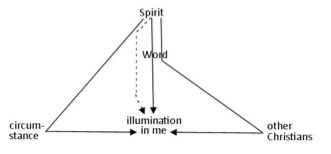
II. Horizontal Exercises
A. Fellowship with other Christians (get)
God is still invisible after Bible reading and prayer; but he is, so to speak, made
visible in his people.
You do not find God just in the inner resources of your private hearts, but in the
assembly of his people.
There are different levels of fellowship that meet different needs. The larger gatherings bring exhilaration and uplift us. Smaller groups and one-on-one mutuality can be used deliberately to get feedback through the monitoring of other mature, caring brothers and sisters.
B. Service to all people (give)
Acts 20:35: “It is more blessed to give than to receive.”
Some personal exercises can have sanctifying effects if we put them in an
interpersonal context and combined with interpersonal activities.
III. Personal Exercises
A. Fasting
Fasting is not particularly religious, but it can be used for spiritual purposes.
1. Types of fasts
a. Partial fasts: one meal a day; forgoing certain foods
b. Solid-food fast
c. Food and liquid fast
Compare abstinence from entertainment, TV, radio, and the like.
2. Effects of fasting
a. Frees us
Freedom arises from the experience of physically not being bound by hunger. We appreciated not being bombarded by drives all the time. Freeing ourselves psychologically from the material world symbolizes the priority of spiritual over material existence. Occasionally not using something (at least “to the full”) gives a person a sense of transcendence over it. Such occasions also allow us to concentrate on spiritual matters.
Fasting can also symbolize freeing ourselves psychologically from the self-centered way of life. “Flesh” has the characteristic of taking something into itself to gain satisfaction; that allows it to become a picture of the self-centered way of life.
b. Sensitizes us
Sensitivity arises from the experience of how good food tastes when you
come off of a fast. Fasting seems also to sharpen the mind.
c. Strengthens our wills
Fasting gives a down-to-earth opportunity for exercising the will. It can
represent the whole area of self-control.
d. Expresses sincerity
(1) Sorrow for sin (cp. Paul at his conversion)
(2) Desire for some benefit from God
(3) Commitment to some goal for God
e. Brings physical results
(1) We do not get progressively hungrier.
(2) We may lose weight—maybe a pound a day.
(3) Our fluid level lowers.
(4) Breath may not smell good.
(5) We become weaker in more strenuous activities.
3. Procedure
a. Do not go more than two or three days without liquid.
b. If you are diabetic, hypoglycemic, or under a physician’s care, do not
fast without a doctor’s advice and oversight.
c. In coming off of a fast, use small amounts of intake at first. Eat fresh
vegetables and soft foods.
B. Meditation
We can live so fast that we do not take time to think about where we are going and how best to get there.
Conclusion
A. Development is a byproduct of action.
1. When we act, we do not just act; we develop.
2. When we want to be “fixed,” we do not sit back and wait for God to do it.
B. Give-and-get illustrates reciprocation.
1. Fellowship and service
2. Seeking God (prayer, Bible reading) and being empowered
C. Raising the level of God-consciousness is the key to growth.
christir.org