
Spiritual Fruit
SPIRITUAL FRUIT
Virgil Warren, PhD
INTRODUCTION
General principle: “We reap what we sow.”
Growth processes + spiritual exercises = spiritual fruit
The basic idea about spiritual fruit: individual fruits are understood interpersonally. (a) They have an interpersonal character, and (b) they arise from interpersonal causes.
I. SPIRITUAL FRUIT
A. Examples of the flesh-spirit contrast
1. Galatians 5:16-25 The Pharisees vs. Jesus, the Judaizers vs. Paul,
2. 1 Corinthians 15 millenarians, and civil religion all have the same
3. Romans 7-8 basic problem of not understanding the spiritual
4. John 3 vs. fleshly nature of the kingdom of God.
Note these typical contrasts: earthly vs. heavenly
world vs. kingdom of God
flesh vs. spirit
law vs. mind
circumcision vs. Spirit
works vs. faith
death vs. life
The conviction is that when flesh stands in contrast to spirit, the terms do not refer to parts of the human person, but to two frames of reference that these aspects of a person represent.
B. Flesh (σάρξ, sarx)
1. Egocentrism
To have satisfaction, flesh has to receive something into itself. To satisfy fleshly appetites, something has to be taken into them (cp. the vice list in Galatians 5:19-21). The “works of the flesh” are all self-centered behaviors, which fits the formal pattern of fleshly satisfaction. So, flesh becomes a code word for sin experientially because sin involves some form of self-centeredness.
2. Ethnocentrism
Galatians 6:13 makes a connection in this section of the epistle with the Jewish impulse toward ethnocentrism. Paul notes that one motivation for wanting to circumcise Gentile converts was that they as Jews could “glory in their flesh.”
Egocentrism and ethnocentrism foster competitive behaviors.
C. Spirit (πνεῦμα, pneuma)
To gain a sense of fulfillment, spirit needs to give something out of itself.
1. Translation question
a. Spirit (vs. Father and Son) In general the word can be
b. spirit (vs. flesh, soul, body) thought of as referring to an
c. spirit as wind invisible reality.
We may think of spirit (a word picture is based on breathing) as a term for what in human nature enables us to engage interpersonally.
2. Interpersonalism
Spiritual fruit is not so much a deposit by the Holy Spirit as it is the fruit of relationship with him.
Since the Spirit represents a system of values, spirit involves a quality of life and standard of living.
Walking by the spirit (Galatians 5:16) means living a transcendent lifestyle.
Interpersonalism is transcendent to the material realm, not opposed to it. Interpersonalism transcends material considerations by impressing on them a value system that stresses the worth of persons, especially persons in relationship. As a result, what a person does is not determined entirely by either side of the relationship, but by the combination. Interpersonalism, then, qualifies the material-fleshly by a higher frame of reference called personal, which is, in turn, transcended by an inclusive approach called interpersonal.
A quality of personal relationship lies above material considerations, or, to put it another way, at the center of meaningful life.
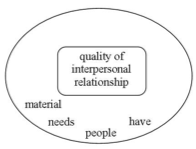
Interpersonalism fosters love.
II. SPIRITUAL FRUITS
Galatians 5:22-23: love, joy, peace, patience, kindness, goodness, faithfulness,
humility, self-control.
NOTE: Lists are not exhaustive, but representative.
parallel, but overlapping.
sequential, but unordered.
Lists do, however, contain items naturally related together.
Here the unifying element is the fact that these fruits are the results of
interpersonalism.
A. Love (ἀγάγη, agapē)
We may ask why love is presented first.
1. Most important? (Matthew 13:8)
2. Greatest? (1 Corinthians 13:12)
3. Originating the rest? (1 Corinthians 13:4-7)
4. Inclusive of the rest? (Galatians 5:14)
Love means things like “caring”
“acceptance”
“mutual respect”
Love retains both sides of a relationship: no self-negation (door mat).
no other-negation (running over others).
Note in this connection Galatians 6:2, 5: “Bear one another’s burdens.”
“Every person must bear their own
burden.”
Love is self-giving for the joy of others, hence, the next virtue.
B. Joy (χάρα, chara)
cp. rejoice, joy, joyful, joyfully
1. vs. happiness, which depends on what “happens”
2. Can exist in persecution (Hebrews 10:34; cp. Matthew 5:10-12;
2 Corinthians 7:4)
pain (Acts 5:41)
trials (James 1:2)
3. Not tied to things (note “flesh”)
4. Caused by a sense of acceptance by other significant people
5. Joy is an act of the will: “Rejoice, and again I say, rejoice”
If something can be commanded, it is an act of the will
(Philippians 3:1).
Our mood for life is not a fate forced upon us.
Joy, based on interpersonal values, is possible in all circumstances; so it is more
stable than fun, based on stimulation, and happiness, based on circumstance.
C. Peace (εἰρήνη, eirēnē)
1. Opposite of division (Luke 12:51)
2. Opposite of disorder (1 Corinthians 14:33)
3. Based on what is stable (Hebrews 12:26-28; 13:11-14)
4. Not the absence of hostilities, but a sense of having no ultimate danger because
we are in harmony with the Ultimate Other.
5. An inner peace, but an inner peace based on relationship to God
6. We can take our defenses down psychologically.
D. Patience (μακροθυμία, makrothymiā)
1. The word picture is “long + desiring.”
2. The idea is not just patience till something else creates the desired result (passiveness) or even enduring opposition while you are trying (positive). It is a self-restraint that does not hastily retaliate. It combines patience, perseverance, steadfastness, and endurance.
E. Kindness (χρηστότης, chrēstotēs)
1. The word picture is “furnishing what is needful.”
2. vs. being abusive (as in hate, competing, not caring)
3. It withholds critical comments even if perhaps they are deserved because it wants to build a person up. Not criticizing applies to people who are trying, but not doing a very good job; it also applies to critical people. Criticizing critical people only makes them worse in their fault. Kindness understands that, to get them to stop criticizing, they must themselves be edified.
F. Goodness (ἀγαθωσύνη, agathōsynē)
1. What can be admired in a person; a term found only in Christian literature
2. See 2 Thessalonians 1:11; Romans 15:14; Ephesians 5:9
G. Faithfulness (πίστις, pistis)
1. Opposite of fickle
2. Faithfulness: the way we act toward other people
a. Keeps responsibility
b. Can be trusted
c. Remains true to commitments
d. “Hangs in there” over time
e. Keeps promises
3. Faith: the attitude we take toward other people’s actions toward us; we trust.
Consequently, faith can refer to qualities on both sides of a relationship: trust
and trustworthiness.
H. Humility (πραΰτης, praütēs)
1. Gentleness
2. Involves appropriate self-awareness and strong self-image
3. Does not operate in a competitive mindset
a. Has nothing to prove
b. Does not have to hang onto positions or authority
be boss
have pre-eminence
4. Self-image not tied to superiority; can feel comfortable not being greatest
I. Self-Control (ἐγκράτεια, engkrateia)
Has an internal set of controls (internal locus of control)
1. We control ourselves (acts).
Do not need to be disciplined by someone else.
Take responsibility for themselves.
2. Environment does not dictate behavior.
Cannot be manipulated by other people or forced by them
Superiority of will over stimuli, drives, and feelings
To put it in a different format:
a. Self-starting (do not have to depend on other people or time pressure
to get going on our work)
b. Self-directed (do not depend on other people or circumstances to plot
our course of action for us)
c. Self-controlled (do not require external laws, force, authority to set the
boundaries of behavior for us)
Examples of questions that highlight our level of self-control:
How would we spend your money if we had an unlimited amount
of it?
What would we do if we had no one to stop us? (power)
Do we set our standards simply for what is passing or what will
“get us an A”?
Do we set our standards higher than the expectancy of people
around us, “beyond the call of duty”?
What would we do if no one would ever know? (secrecy)
Are we good only because we are not in an environment that
tempts us?
CONCLUSION
“Against such things there is no law” (Galatians 5:23).
A. Not just because no one wants to forbid such things
B. but because law generally concerns itself with forbidding behaviors that arise
from fleshly orientation and material concerns
1. Such behaviors involve running over other people
denying their worth
denying their personhood
manipulating others for personal gain
2. Such behaviors reduce personal relationship to egocentrism and
ethnocentrism.
christir.org