
The Christian Mind
THE CHRISTIAN MIND
Virgil Warren, PhD
INTRODUCTION
Our mind affects our relationship to God: Psalm 139:1-2. We cannot exempt our thoughts from what righteousness measures.
1. God knows our hearts: Luke 16:15; Proverbs 21:1; Romans 8:27;
1 Samuel 16:7; Acts 1:24-25.
2. What we think is what we end up doing.
I. WHAT WE MEAN BY “MIND”
We are dealing with “mind” functionally, not as a faculty.
So, we are not dealing with
A. the relationship of mind and brain,
B. outstanding mental brilliance like photographic memory or a high I.Q.
We are interested in mind as part of what enables us to operate interpersonally and live life abundantly.
II. WHAT MIND ENABLES US TO DO
project our viewpoint of consciousness to another time or place
ideas imagine what is not (creativity) or is not perceivable
reorganize the visible environment
A. Receiving word revelation (RATIONAL)
Mind gives (1) awareness of ideas and (2) the possibility of communication. Mind is a point of contact for divine revelation (1 Peter 1:8: “not having seen, we love”).
B. Living by values (MORAL)
We can live by values that do not arise from experience (Proverbs 23:7: “As people thinks so are they.”)
1. Values vs. instincts (inborn stimulus-response actions)
We may have to bring these alive by experience, but they are genetically
there already.
vs. drives
vs. habits (the ability to put things on automatic pilot)
2. Self-transcendence
Transcendent lifestyle/objectiveness/getting out of ourselves/conscious
living/authentic existence
a. New birth: John 3:3-8; cp. 1 Corinthians 15:50; Romans 12:2
b. Crucified lifestyle: Galatians 6:14; 2:20
c. Resurrected lifestyle: Romans 6:2b-13; 8:11 (cp. 1 Corinthians 15:33-
34)
d. Ascended lifestyle: Colossians 3:1-5 (cp. Philippians 3:17-21)
e. Heavenly in origin: John 3:3; 1 Corinthians 15:45-49
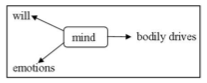
3. Frame of reference for other aspects of ourselves
a. Awareness of ideas
b. Possibility of communication
c. Ability to get outside ourselves
d. Orientation to the emotions
e. Boundaries to bodily drives
f. Direction to the will
g. Guidelines for the conscience
h. Capacity to get behind the eyes of someone else
i. Possibility of a sense of humor
organizing center
C. Relating socially (SOCIAL)
Mind enables us to project consciousness over behind the eyes of someone
else and to see things through that camera.
D. Coping with circumstances (PSYCHOLOGICAL)
We can reorganize reality, so we live by the world that is inside our minds, which gives us psychological strength.
1. We can stress what we want out of what there is. (value)
2. We can select from what there is. (quality)
We can concentrate on strengths, successes, and virtues.
The result is patience, endurance, perseverance: Hebrews 11:27.
The goal is to get our mind into primary position rather than to have flesh, emotions,
or want be primary.
The aim is to attune the mind to God’s guidance more than society’s expectancies.
III. HOW TO IMPROVE THE MIND
We are concerned here with what we think about (content) as well as how well we
think (efficiency).
A. Beginning with a correct world view (correctness)
1. Correct view of God and people: Romans 1:21-28; cp. Psalm 53:1
Perverting the understanding of God (philosophical atheism)
Not keeping a conscious awareness of God (practical atheism)
2. Consequences of a false view of God
self-centeredness perverted understanding: sin
“serve the creature” (1:22-23 + 24-25)
sin
pleasure refused awareness: sin
“reprobate mind” (1:28 + 29)
B. Providing the mind with wholesome subject matter. (goodness)
1. What we feed our minds is what it dwells on.
books we read cannot practice avoidance entirely
TV programs watched (1 Corinthians 5:10)
company we keep cannot say not to think about this;
job we take we are thinking about it by saying not to.
movies we go to
a. Not seeking compromising situations and sensual experiences.
b. Doing positive things:
(1) Staying around good people
(2) Reading inspirational reading
(3) Memorizing scripture
(4) Meditating on positive things: Philippians 4:8
2. What our minds dwell on is what we do.
a. when strong temptation comes or restraints and peers are removed.
b. Philippians 4:9: “the God of peace will be with you”
C. Sharpening the mind by using it.
1. Clearer understanding: Hebrews 5:11-14
2. Better evaluation (application of revelation to living situations). The more
we use our senses correctly the better they work.
3. Greater appreciation: Psalm 1:2
4. The mind is dulled by . . .
a. inactivity/passiveness/seeking authorities to do our thinking for us
b. rationalization
christir.org