
The General Picture Of
THE GENERAL PICTURE OF
PRACTICAL CHRISTIAN LIVING
Virgil Warren, PhD
Christianity is a religion to be lived, not a philosophy to be believed. Christianity addresses the practical situation with relational living as the ultimate concern: behavior in relationship to God and other people. To put it more basically, the central issue in Christianity is interpersonalism together with its sub-units (rationality), those secondary non-essential factors (physical nature), and those matters that can be added to interpersonalism for practical purposes (legal authority and natural force).
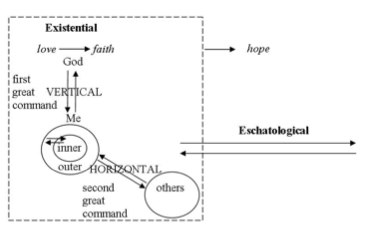
The accompanying diagram summarizes the basic aspects of life. There are two primary dimensions: the existential, which refers to the present situation in which we “exist,” and the eschatological, which refers to the forward movement of life. “Latitude” and “longitude” respectively are terms that could serve to indicate these same two dimensions.
Within the existential dimension there are two directions: vertical relationship with God and horizontal relationship with other people. In the context of those two directions personal development takes place.
Within the personal dimension there are inner and outer factors.
Between each pair of factors reciprocation takes place. Reciprocation is a causal pattern in which two or more poles exchange input in both directions. Vertical relationship from God to people leads to people’s response to God. Horizontal dimension influence runs in both directions between “me” and “others.” Interaction takes place also between people’s inner factors (motives, heart, will, thoughts, feelings) and their outward behavior. The present circumstance has a direction-setting effect on the future, and the projected future we hope for has a qualifying effect on behavior in the present.
I. God-to-man relationship
A. Prayer
B. Worship
C. Divine guidance
D. Meaning
E. Lord’s Supper
F. Freedom
G. Stewardship
H. Faith
Love serves as the splice between God-to-people and people-to-people.
II. Man-to-man relationship
A. Weaker brother relationships
B. Leadership
C. Fellowship/Christian unity/society
D. Evangelism/mission/influencing for Christ
E. Marriage
F. Parenting
G. Conversation
III. Personal development
A. Possessing the body
B. Dealing with temptation
C. Strengthening the will
D. Managing the emotions
E. Enhancing self-image
F. Coping with suffering
G. Christian mind
H Growth processes
There are several “short cuts” that people commonly substitute for the reciprocating, interpersonal processes that characterize the existential and eschatological dimensions of life: (a) information/“truth”/correct doctrine, (b) rigid moralism, (c) ritual, (d) programs, (e) legalism.
christir.org