
Holy Spirit as Interpersonal
HOLY SPIRIT AS INTERPERSONAL
Virgil Warren, PhD
I. The gift of the Spirit is first of all an interpersonal relationship.
The Holy Spirit is a person, not a force, a power, a feeling, an atmosphere, idea, principle, or attitude. He is not God’s energy. Since the Spirit is a person and people are persons, “having the Spirit” means relating to deity in the person of the Spirit. Consequently, his guidance and empowerment come first through interpersonal means—influence before miracle.
He operates (a) through scripture, (b) through the influences of people influenced by scripture, and (c) through the sheer relationship itself.
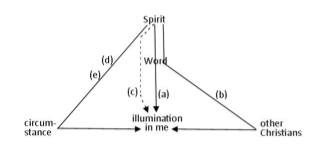
In addition to these purely interpersonal operations, there may come supernatural operation (d) through special divine providence and (e) through manifest miracle.
Indwelling is understood figuratively rather than literally. God the Spirit is not a force that literally permeates a person’s body or locates itself inside each Christian. Sinners, then, are not holes in the universal, omnipresent Spirit. Indwelling refers to close personal association that influences a person from the inside out. It is comparable to statements like, “You can just see his mother in him” or “What’s gotten into him?”
In Ephesians 3:17-18 Paul says that the Spirit dwells in our hearts by faith. The nature of the indwelling corresponds with what causes it—faith. The empowerment comes from an indwelling brought about by faith. The same goes for guidance, unification, and intercession, the other effects of the Spirit’s work
The break between objective and subjective allows error to enter the picture, which explains why people can think they have received revelation when the subsequent verdict of time disqualifies it as divine revelation. This format likewise shows how empowerment can occur even when there is no objective basis for it.
Since Christianity deals primarily with interpersonalism, it cures primarily through interpersonal means. So psychological strength and the power to cope with suffering come first through interpersonal means. The indwelling of the Spirit is the positive relationship between the personal Spirit and a human person. The indwelling is non-locational; indwelling is an image for all-pervasive influence and character.
II. The gifts of the Spirit become such by way of the interpersonal relationship itself.
Aside from supernatural endowments, innate abilities and developed skills become gifts of the Spirit when a person comes into fellowship with God. Abilities and skills become gifts of the Spirit via their new context as well as the new motivation and value system that reshape their use and connect them to different goals—the goals of the Spirit of Christ. Even supernatural endowments retain the interpersonal element by coming from a person rather than something impersonal. Inborn talents and developed skills become gifts of the Spirit when a person comes under the influence of the Spirit.
III. The gifts of the Spirit are for interpersonal use.
Spiritual gifts are interpersonal in that (1) they are not for benefiting animals, plants, or things (healing, e.g., was never used for healing animals) and (2) they are not for the individual, but for others.
All gifts of the Spirit appear in interpersonal settings, whether talents, abilities, or supernatural endowments. In no case did Christ, the apostles, or anyone else ever use a supernatural gift for personal gain. They are used on persons for persons, and they are used on other persons. Jesus did not come down from the cross to save himself; he saved others. He did not turn the stones to bread to feed himself. He did not cast himself down from the pinnacle of the temple to get attention of worshipers below.
Our point here applies also to language speaking. Language speaking is not intended to uplift the person particularly (although, of course, that would be a byproduct). In the New Testament, languages were always used to communicate to others as in proclamation and exhortation or communicate for others as in public prayer. They were actual human languages.
Consequently, interpersonalism correlates with the nature and use of spiritual gifts. All spiritual gifts are for use between persons. They are not—as in the notion of private prayer language or being slain in the spirit—for the purpose of self-application. They are not experiences for their own sakes nor ends in themselves.
Jesus interpersonalized his miracles by doing them to benefit people rather than for sheer supernatural display. In this respect, divine miracle differs from demonic manifestation, which is negative or at best neutral on interpersonal considerations.
Jesus further interpersonalized his miracles by doing them on the condition of faith. He did not need the recipient’s or sponsor’s faith to succeed, as the case of Malchus shows. Jesus did not do miracles to satisfy curiosity—as for Herod (Luke 3:8). His efforts were calculated both to authenticate him, to benefit persons, and to draw people to God. Consequently, most of his signs were healing miracles. Faith was involved in these as a required condition and a calculated result.
IV. The fruit of the Spirit is interpersonally produced by influence rather than by supernatural deposit.
Interpersonal influence is the manner in which the ordinary effects of the Spirit are produced in a person’s life. The fruit of the Spirit is all the interpersonal kinds of fruits and are produced interpersonally rather than supernaturally.
V. The interpersonal takes precedence over the miraculous in Holy Spirit matters.
The interpersonal aspects of the Spirit (gift of the Spirit, indwelling, fruit bearing) are uniform for all Christians at all times and places, whereas the supernatural is associated with specific persons and at special times, places, and circumstances. The supernatural is not always involved, but the “ordinary” is always present and normative.
In summation, the origin, content, nature, purpose, and use of spiritual gifts are interpersonal.
christir.org